I often look for fresh insights to the importance of education and ways to highlight to fellow Americans the equal humanity of Palestinians. Fortunately, Brian Barber’s book, No Way But Forward: Life Stories of Three Families in the Gaza Strip (2025) provides both.
- A theme throughout, and reflective of Palestinian culture, is that education is as at least as important in Gaza as any place in the world you might imagine. In comparison to more privileged communities, education is recognized from an early age as a foundation for the future and an opportunity provider.
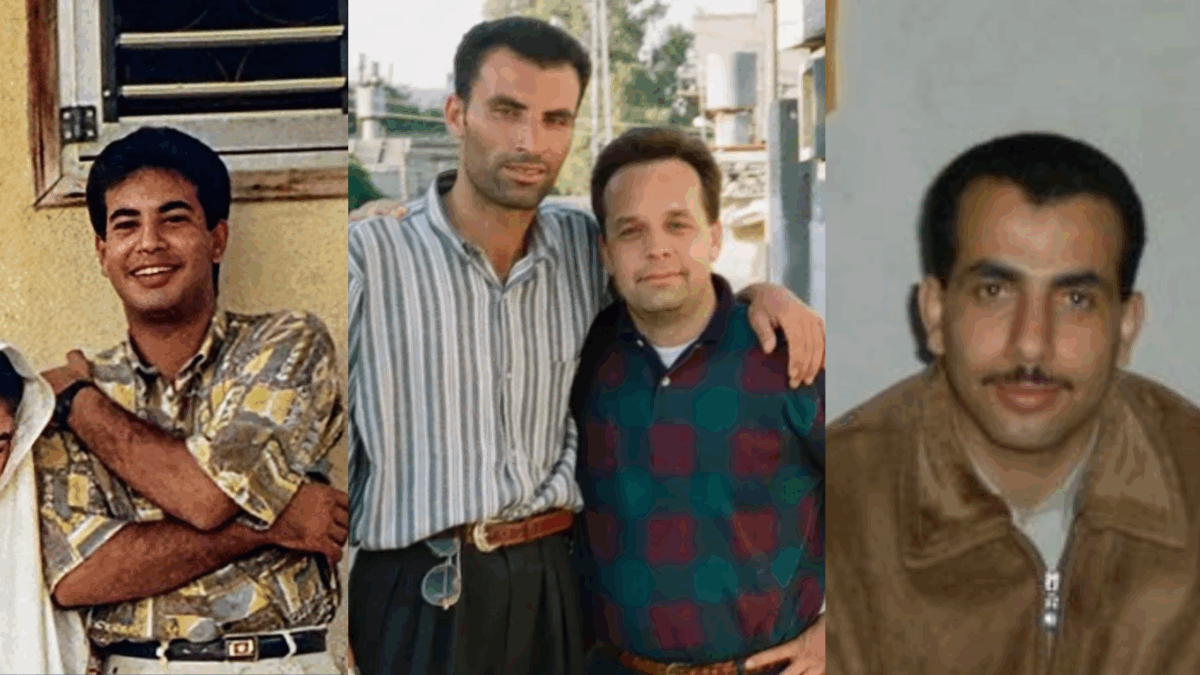
Before we go to the biographical summaries (picture attached), here’s a link for those who want to see the author’s website and/or order No Way But Forward: https://bkbarber.com/books/
Hammam Faqawi. We first meet Hammam–who goes on to becomes a teacher like his father, Fuad, and then a headmaster, earning a Master’s degree at Al-Azhar University in Gaza—when he’s 5 years-old (1980). His mom—Fatima—readies him for the first day of kindergarten:
- a crucial day, as it was for every Palestinian child. In a culture that regards education as vital, it was ‘the first step of the ladder of the life,’ as the saying goes.”
Two weeks after October 7, 2023, Hammam chances upon his student, Mahmoud, displaced from Gaza City and living in a school.
- The young student says: “You will come to teach us again. There are many students from our school in Gaza [City] but we lost the books. We came from Gaza with only our clothes on…many of the students of our school said their homes were bombed…and some were pulled out in pieces from under the rubble.”
- Mahmoud’s little brother also recognizes Hammam: “you are the teacher who teaches Mahmoud…Come on, come to the school. We now live there. Come and teach us there.” Hammam cried, understanding that the “child wants to learn even in these very, very difficult circumstances. This child conveyed to me, with the innocence of childhood, that knowledge is a message and there is a future.”
- April 2024, Hammam texted Brian: “Now a new suffering has begun…I want to provide an opportunity for education for children…Everything is destroyed…There is no education. No universities, and no future for the children. For the first time in my life, I feel helpless. I want to change my children’s lives. I want them to learn.”
- July 2024: “My kids are asking me questions I can’t answer. They are asking about their future. They’ve lost one year of learning, and the second will start soon.”
- December 2024. Hammam’s brother Hani is severely injured but survives an Israeli missile strike while driving his Save the Children car.
Khalil Abu Shammala. Khalil and his siblings received an education in morality and community at their mother—a refugee from Barbara in present-day Israel—Tammam’s knee, in addition to their formal schooling. Khalil went on to become the Exec. Dir. of the Gaza-based Al-Dameer human rights organization from 1998 to 2014.
- The impact of education on Khalil, including “the Academy of the Palestinians” (prison) was lifechanging:
- “If the naivete Khalil had always felt had been transformed through his intifada [1987-1993] experiences—his initial detention and subsequent imprisonment—his years as a student political leader while earning his bachelor’s degree in English literature catapulted him into a self-assured young man of twenty-six (1996).
- Post-October 2023, Khalil’s kids, Nour and Mohammed, graduated from Al-Azhar before October 7, but his daughter Nesma’s computer engineering studies at the same university—she was to have been hired by Google as a web developer upon graduation–were interrupted by Israel’s destruction of Gaza.
- September 2024. Nour is accepted into a master’s program at the University of Jordan, to study remotely. “She is so happy.” She takes the risk of daily travel to find an internet connection.
Hussam Abushawish. Hussam is 13 when we meet him (1986) and grappling with the dissonance between his grandmother’s assertion that his people were the inhabitants of Palestine/Israel–hailing from Barqa, a few dozen kilometers from Nuseirat in Gaza, where they now lived—and his undeniable reality that Israeli soldiers controlled their lives.
- Hussam resolves this cognitive dissonance with several months of research, after which he creates a poster board describing the history of Palestine that he places in his classroom. The headmaster quickly makes him remove it, fearful of the consequences should Israeli soldiers discover it, as schools were forbidden from teaching Palestinian history.
- Two years into the 1st Intifada, when Hussam was 16 (1989), his dad, Fares, gave moral guidance for the future with primacy to education: “…like your mother and I have said before, you must not let your political activity interfere with your studies. Above all else, your education will equip you to serve your people, your cause, our cause. Our struggle will likely go on for a long time in the future, so you need to strengthen yourself with the knowledge and skills that education will provide.”
- Post-October 2023, Hussam’s brother Omar was killed while returning home from a daily jog on Oct 7. In Hussam’s words, “That missile was the very one that didn’t grant him the opportunity to continue his pursuit of knowledge, work, and poetry. It robbed him of the chance to embrace fatherhood to a three-year-old daughter named Elena.”
- May 2024. Hussam’s wife loses a second brother, in addition to two nieces and a nephew during the first 7 months of Israeli airstrikes.
The book’s narrative ends on October 7, 2024, with an epilogue last December 20.
- Each family relocated multiple times, returning to the remains of their homes when possible.
- Their search for food and struggle against disease is constant. The situation now is immeasurably worse. As one of the men says, “there is no bottom in Gaza.”
- None of them would voluntarily leave Gaza. But they want their children to have a better life.
Last week/this week. Last Saturday at Carderock, Basel and Reza ran 20 miles, as did Cathy in Minnesota, while Basma ran 10, and Mazen and Jorge walked 8 and ran 6, respectively. This Saturday, we’re running at Columbia Island Marina—everyone is running 12 miles.
And shout out to Basel for stepping up to host!
No way but forward to a brighter Palestine.
 iqraadc.org
Leave a comment