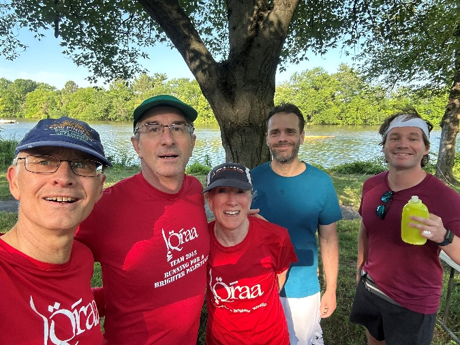
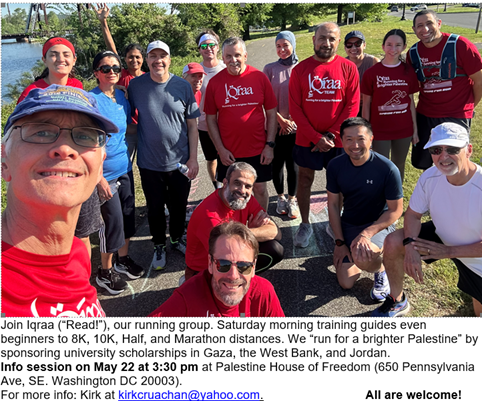
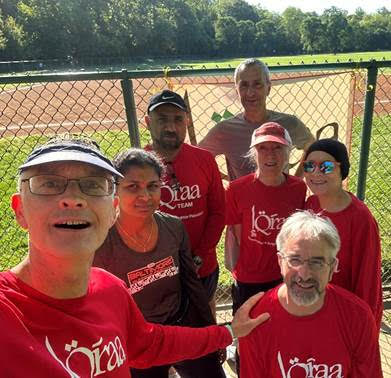
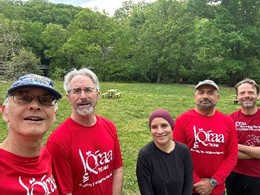
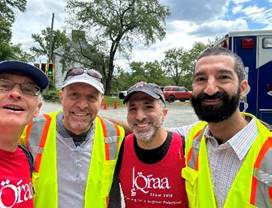
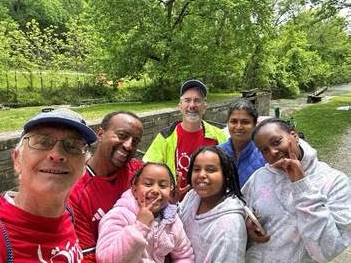
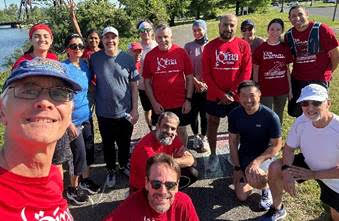
We had a rare fair-weather fun run on Saturday, boosting turnout and kicking off our 2026 campaign. Several prospective new runners joined us as we ran/walked the Anacostia trail just ahead of this week’s info sessions on Wed (Apr 22) at 6:30 pm and Sat (Apr 25) at 1 pm.
If you’re interested in an info session, I’ll send the address or meeting link; you can attend in person at United Palestinian Appeal’s Dupont Circle office or via Zoom.
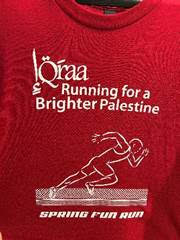
For last Saturday, we owe huge thanks to UPA for their work in designing the popular Iqraa fun run shirts and especially UPA staffers Tabitha and Frances who came out to provide logistical support and make refreshments available. While Tabitha managed check-in, Frances—who traveled from San Antonio for the week—also ran with us.
Iqraa fun run, Anacostia Park (Apr 18)
As we start this year—the first training run is May 9 at Peirce Mill–here’s our simple 3-part “Why Iqraa” message for anyone who’s interested.
First, we make a difference. Last year, we raised more than $36,000, roughly equivalent to 36 university scholarships, each $1000 is roughly a year’s tuition—according to UPA.
This year we’re going to exceed half a million $US in total fundraising since Iqraa’s birth in 2008. That’s 500 student-years (tuition covering 500 students for one year each).
That’s our tangible impact. We also raise awareness along the trails, wherever we train, wherever we race, wherever we go wearing the red and white Iqraa shirt.
Running for a brighter Palestine is an eye-grabbing message and one we’re proud of carrying across the District, Maryland, and Virginia… and beyond.
The third reason—in addition to the scholarships and awareness-raising—is that Iqraa is a safe place to be yourself and recharge emotionally. As Mazen, who’s run with us since 2009 said after Saturday’s fun run, these are beautiful people we run with.
Why Iqraa? To run for a meaningful cause, enjoy the area’s trails and green spaces, for the meditation—or conversation—of a good run (or walk), and to grow good friendships.
All are welcome to join us in Running for a brighter Palestine.
Saleem Al-Naffar, a Palestinian poet in Gaza killed by Israel along with his brother and their wives and children—thirteen family members—in December 2023, wrote these lines that appear at the end of the epic film, Palestine ‘36 (playing daily thru Apr 15: Angelika Film Center at Mosaic).
From the land, we grew.
Our river birthed creeds and bloodlines.
Our rhythm has always been—die standing.
In spite of wretched planes
and all that life fractures, we remain.
Even if skies crush our land
our song sings on.
Naffar captured so much history, pain, and beauty in those few words: the land, its creativity and culture; the rootedness of the people of the land, withstanding oppression. Survival via sumoud (steadfastness), and even eternal hope.
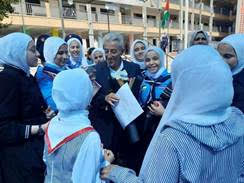
Saleem Al-Naffar visiting Gaza school, Oct 5, 2023
While the people of Palestine will determine what to do in the face of genocide and ethnic cleansing, we can bolster Palestinian hopes and steadfastness through our own solidarity. For Iqraa that means being present when possible, representing for a brighter Palestine, and specifically, funding education.
Education is the most powerful tool imaginable for survival and advancement, as scholarship enhances sumoud, generating a resourceful resilience. Education provides opportunities for personal growth and is a multiplying force for community strength.
If you want to help, here are Iqraa’s upcoming events…we welcome your presence.
April 18 at 9:00 am in Anacostia Park: 5K fun run/walk for Palestine (link below)
April 22 at 6:30 pm at UPA’s office and by Zoom: info session for new runners
April 25 at 1:00 pm at UPA/Zoom: info session for new runners
May 1 time TBD: volunteers to help with logistics for May 2 race: need 2 vols
May 2 Potomac River Marathon and Half: need 3 aid station vols at Lock 7 (C&O canal)
May 9 at 8:00 am at Peirce Mill (Rock Creek Park): first MCC training run (link below)
For the fun run or the Marathon Charity Cooperation training program, register at the links below. For everything else (to volunteer or RSVP for an Iqraa info session), just let me know.
Note about Marathon Charity Cooperation training: we/MCC typically start on the first Saturday of May (continuing every Saturday thru October), but that happens to be the day MCC adopted the Potomac River race (May 2), so we’re delaying the start of MCC training until May 9 this year.
Our song sings on every year with this refrain: Running for a brighter Palestine!
My Mom, Dana Dunbar Howe King, passed away at home with my sister Melissa at her side on March 20 after a full life of 92 years, lovingly narrated in her obituary.
Mom loved history and writing and published her works on family and the Middle East at Howe About Books. The first, All About US in the Middle East, was for children, featured simple, loving drawings on every page, and was told through the eyes of her oldest son, 7 years old when we arrived in East Jerusalem in January 1967.
A sense of adventure sent her traveling to find her place in life after graduating from the University of Texas (1955). She worked in New York City and then sea fared over the Atlantic. During the Cold War, generations of Americans and their families would serve in Europe, charged with protecting a newly reshaped world order—until then rooted in intra-European competition and colonialism—from predatory and expansionist authoritarianism. In that place and time my Mom met my Dad, a U.S. Army officer.
A decade later, Mom brought our family with four children to the Middle East, where my Dad was seconded to the UN Truce Supervisory Organization. From January 1967 to November 1969, we lived in East Jerusalem’s YMCA; the West Bank village of Beit Hanina; Tiberius, Israel by the Galilee; and Beirut, Lebanon, the “Paris of the Middle East”—a place and time that opened Mom’s eyes to the reshaping of another regional order.
Newly independent Arab states were navigating a path they saw as perched between liberty and security, while Western-backed Zionism grew within the British Mandate of Palestine, emerging as Israel in 1948. During this time, through to our first year in Palestine, Israel forcibly displaced more than a million Palestinians in the Nakba (catastrophe) of 1948 and the Naksa (setback) of 1967.
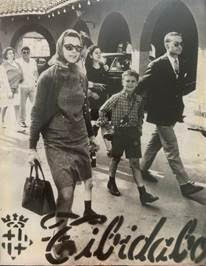
We were kids; our Mom experienced these events and the people affected in a range of personal ways. In her Middle East series for children, she gave us simple meanings without dwelling on politics, except the obvious. Personal connections came from talking to George, one of the Palestinian waiters who served our breakfast—he called my brother Bruce “Mr. Cornflakes”—at the YMCA in Jerusalem. Insight came from talking to the Jordanian officer who warned us he could still see light—which could facilitate aerial targeting by Israel–shining through the blackout curtains of our West Bank apartment in the days before the 1967 war.
George and other waiters at the YMCA, 1967
Mom was responsible for evacuating our family to Rome—Dad, as a UN observer, remained in the Jerusalem area—in early June and bringing us back after the war. We had many more memories than space permits, but these vignettes represent events we discussed multiple times in the decades since. They reflect her perspective of a new regional order—anchored on Israel’s security and backed by America with little if any regard for the policy implications on Arabs and others in the region.
Disapproval of the “men with guns” in Israel waving down civilian vehicles for a ride, a jarring reality that reflected a cocky post-1967 militarism.
A sensibility for justice offended by Israel’s razing of the Maghrebi (Moroccan) quarter in June 1967, immediately after its conquest of Jerusalem; it forcibly displaced hundreds of Palestinians to make way for the Western Wall plaza.
Witnessing from our apartment a dozen civilian Lebanese aircraft burned by Israel in December 1968 at Beirut International Airport in “retaliation” for earlier PFLP attacks. This personalized subsequent decades of such Israeli reprisals against civilians, especially in Lebanon, Gaza, and the West Bank.
Routine use of the phrase “all planes returned safely to base”—until Gaza—as reassurance after completion of air travel. We’d routinized this phrase from Israeli radio, where it was unfortunately a reflection of Israeli’s reliance on punitive airstrikes.
As a result of such experiences, Mom understood the ethnosectarian power dynamics in Palestine. For instance, her second children’s book, More About Us in the Middle East, recognized Israel’s 1968 National/Independence Day with her touching drawing of a Jewish boy holding an Israeli flag along with the notification that, “Even now, the Palestinian people continue to struggle under cruel conditions of the Occupation.”
Such observations of unfairness by our Mom—injustice I was blind to until after conscientious study and reflection on my numerous disagreements with her–ultimately led me to recognize the source of our different understandings. The dominant narrative in America favors Zionism; the Establishment has for too long privileged the lives and narratives of Israeli Jews over others.
While Mom encountered Palestine/Israel as a conscientious adult, I was a boy; when we returned to America, everything I read in the mainstream media reshaped my understanding of what I experienced, explaining away the injustice and oppression as the legitimate security needs of ordinary Israelis.
The wake-up call for me—to resolve the cognitive dissonance between my eyes and what I read in mainstream media—came from Dana Howe on Palestine.
Our Mom often spoke about the principles of fairness that should guide our lives. Her views were intense—she grieved injustice in America and in the Holy Land–and she was not shy about expressing judgment. Fittingly, Psalm 10 will be read at her funeral service on April 11 in Richmond; all are welcome. Excerpts:
Why, Lord, do you stand far off? Why do you hide yourself in times of trouble?
In his arrogance the wicked man hunts down the weak, who are caught in the schemes he devises…
He lies in wait near the villages; from ambush he murders the innocent. His eyes watch in secret for his victims…
He says to himself, “God will never notice; he covers his face and never sees.”
Arise, LORD! Lift up your hand, O God. Do not forget the helpless…
You, LORD, hear the desire of the afflicted; you encourage them, and you listen to their cry,
defending the fatherless and the oppressed, so that mere earthly mortals will never again strike terror.
Our 19th season approaches and we’re going to kick it off with our 2nd annual 5K fun run in Anacostia Park!
Here are the rules of a fun run: Have fun!
This is a great opportunity to meet some fellow “Free Palestine” friends, enjoy the outdoors along the Anacostia River—almost where it meets the Potomac—and check out Iqraa (Read!, in Arabic). We’re runners who support United Palestinian Appeal’s scholarship program.
Here are some other details:
UPA designed this beautiful t-shirt for our annual race!
Also:
Entry fee is virtually nominal: $10 to register, $20 if you want the shirt, and of course additional donations are welcome–though purely optional
The fun run will start at 0900. To navigate there: 1500 Anacostia Dr, Washington, DC 20020. It’s the Anacostia Park Roller Skating Pavilion (we’ll meet on the river side).
This info and a map is in the registration link below too.
The fun run—you can walk; remember the rules—will be followed by a reception featuring Jenin Pastry’s maamoul.
Here’s the link (below) to the Afternoon of Palestinian Culture my church—specifically, our Holy Land Committee—hosted last Sunday. More than 90 people came to see this beautiful event, including many Iqraa sha’b, beginning with our poet laureate, Zeina Azzam, who was one of the featured artists. I told her afterward that I had to bite my lip during some of her poetry; it was painfully real.
Our priest, Sari Ateek, gave the welcome, and other speakers/artists included Nizar Farsakh of the Museum of the Palestinian People; Fuad Foty, who played the oud; Lema Bashir-Boulghassoul, who spoke about tatreez, and Malikat al-Dabke, who danced.
Our reception afterward featured Jenin pastries, and the event raised approximately $3,000 (unofficial total) for Bright Stars of Bethlehem, Project Rozana’s mobile medical clinics, and United Palestinian Appeal.
Another Iqraa alum, Jay Mallin, supported our event, providing the world-class professional A/V recording you see here.
While it’s hard for a single video camera trained on the performers to capture the connection these artists established with the audience, every word, note, step, expression, color, and beat comes through.
Shout out to all our Iqraa alumni who showed out, including Maha and Osama, and their daughter Lena (with a future Iqraa runner), Bill, Bilal, Ramsey and his daughter, Khaled and his wife, Reza, Samar, Sawsan and her husband, Shobi, and as noted, Zeina, Jay, and me. I hope I’m not forgetting anyone.
This was an afternoon filled with love and pride and I’m grateful to share it.
As Spring and the new running season approaches, it’s time to open your calendar and mark down a few dates.
First, this Sunday (March 1) afternoon at my church (2 to 4 pm), we’re hosting a rejuvenating and spirit-building Afternoon of Palestinian Culture. Apologies for scheduling this during the Ramadan fast, but we simply didn’t think enough last October when I discussed this with my church.
The other upcoming events are all running and Iqraa focused (and after Ramadan):
April 18 5k fun run at 0900…still tentative, as UPA seeks to confirm Anacostia Park
· April 22 info session at 6:30 pm…at UPA’s Dupont Circle office (also available by Zoom)
· April 25 info session at 1 pm…at UPA (and via Zoom)
· May 2 training run at 0800…first training run of the year, with Marathon Charity Cooperation, our partners.
We look forward to seeing you all soon. Ya’teek al-‘afiyah!
How rare it is for two Abrahamic religions to coincide on such similar holy days: a period of sacrifice meant to help us appreciate the simple blessings in life—of which there are many—while understanding how fortunate we are.
We do this through fasting or similar sacrifice that compels us to change our routine and reflect on what’s truly important, while considering more seriously the needs of those less fortunate—of whom there are many–and in all this we deepen our spiritual connections and draw closer to the divine.
Although shorter, the Jewish day of atonement—Yom Kippur—is very similar in purpose.
For today’s message, Basel of our 2025 team, graciously shared his reflections in response to my request for his thoughts about Ramadan as an Iqraa runner.
First, though, we owe respect and blessings to Rev. Jesse Jackson, who passed away last night, at the age of 84. Known for his stump slogan that recognized the equal value of every individual—“I am…somebody”—Jackson had the moral conviction to disregard American Establishment efforts to suppress discussion of Palestinian rights. Jackson met with PLO chairman Yasser Arafat multiple times, including here at the World Conference Against Racism in South Africa in 2001.
Here are Basel’s reflections on Ramadan:
“Some of us in Iqraa will be observing the fasting month of Ramadan. The month is a transformative experience, physically, mentally, and spiritually. To my fellow runners, this might be familiar. Every week of the month resembles a stretch in a race. The first mile is always the hardest, so is the first week of Ramadan. Slowly, your breathing and body find their rhythm, and you mentally elevate to a state of real confidence and drive.
This is also what you experience halfway through Ramadan when you feel closer to something higher than yourself, that there is more to life than just the dreary cycle of material consumption. That is also when you realize that you are far stronger than you thought you were, that you can get by with little food and rest and still feel happy because you thought of others and made sacrifices for them, be it God, the poor, or for Iqraa, the Palestinian students waiting to have a fair chance in the grand race that is life. That thinking of others is the essence of the Ramadan experience. As you draw closer to the finish line, you are exhausted and wobbly but happy.
That happy feeling for Iqraa runners is also mixed with a deep sense of sadness and reflection as we think about the lives of Palestinian students in the Holy Land and their daily hardships. Bittersweet are also the last days of Ramadan, when you realize that this meaningful spiritual journey, in which you were deprived of normal rest and your sustenance was constrained, has made you better in many ways. May you continue to run well, and may your Ramadan be blessed.
Saturday morning in Minneapolis was hard to take because we love our country. For the community that fights untruths and indifference to seek justice for Palestine, ICE brutality and MAGA community support for it is unsettlingly familiar.
This familiarity comes from decades of witnessing oppression in Israel-Palestine, the images and sound bites of which reverberate in America as echoing shocks in recent years, climaxing—for the moment–on January 24.
“We wake with
no words, just woe
& wound. Our own country shoot
ing us in the back is not just brutal
ity; it’s jarring betrayal; not enforcement,
but execution. A message: Love your people & you
will die. Yet our greatest threat isn’t the outsiders
among us, but those among us who never look
within. Fear not those without papers, but those
without conscience. Know that to care intensively,
united, is to carry both pain-dark horror for today
& a profound, daring hope for tomorrow. We can feel
we have nothing to give, & still belove this world wait
ing, trembling to change. If we cannot find words, may
we find the will; if we ever lose hope, may we never lose our
humanity. The only undying thing is mercy, the courage to open
ourselves like doors, hug our neighbor,
& save one more bright, impossible life.
~Amanda Gorman, For Alex Jeffrey Pretti (2026)
Meanwhile, the everyday prose of social and political life that was our custom—friendly or heated debates over the meaning of events and the appropriate policy response—have evolved since January 6, 2021, into often righteous anger over disagreement on basic facts.
One theory of how this happened is that for too long there’s been a lack of integrity in the morality Americans believe we bring to the world. We proclaim in favor of freedom and equality–universal rights. Our actions often belie our words. Nowhere is the dual standard more manifest than on Israel-Palestine.
Why it matters
Both U.S. political parties, but especially the Democrats—who for decades claim to stand with integrity for such universal values as justice and equality—reveal a moral core hollowed by this dual standard. How much more difficult it is then to face down the lies of January 6 and after, when their MAGA purveyors throw them back, alleging hypocrisy.
In addition, the Democratic party is needlessly weakened—an own goal—by internal division between progressives who believe that everyone is equal and “progressives except on Palestine” (PEP) who make exception for Zionism, which privileges Israeli Jewish lives and narratives over all others.
Belief in the universality of equal rights is not radical, but PEP and our society more broadly treat it as such regarding Palestinians. If you doubt this, try insisting publicly on Palestinian rights and freedom at work or school or places of worship the way you might for Ukraine or against antisemitism. Results may vary—“why this bias?” … ”that’s too political” … “do you support Hamas?” or “that’s not appropriate for this campus”—but are generally not welcoming.
Nevertheless, a united progressive movement, whether that’s the Democratic party or something else, is not possible until progressives truly unite and act with integrity around our core moral values.
Separation Wall with image by Lushsux; honors Palestinian Iyad Hallaq, killed by Israeli police
in Jerusalem the week Minneapolis police killed George Floyd.
America and Israel-Palestine
After Israel’s 1967 war victory, America became Israel’s primary strategic patron, succeeding Britain and France. Ties became so close that Israel could rely on the US readily vetoing and hollowing UNSC resolutions critical of occupation, settlement building, and military aggression, and US condemnation or counterefforts on UNGA actions favorable to Palestine or that described Zionism as racism. Meanwhile, Americans celebrated Israeli leaders such as Prime Minister Golda Meir—the most admired woman in America in 1974, according to Gallup—who declared in 1969, “there was no such thing as Palestinians.”
Inside Israel, the political seeds of thought that justified the 1948 Nakba (Catastrophe)—driving 750,000 Palestinians from their homes—bloomed with the military occupation in 1967. The Jewish population dominated by Labor Zionism during initial immigration and the founding of the state turned steadily rightward after the 1967 war. Israel began building settlements even before the September 1967 Arab summit’s “three No’s.” By 1977, with settlement building under way for a decade—beginning in Syria’s Golan in July 1967—but growing in the West Bank, Gaza, and East Jerusalem too, the right-wing Likud replaced Labor as the dominant force in Israeli politics.
Over the decades, America directly linked both our strategic and moral outlook and our policy thinking for the region to inherently racist Israeli policies, which were implemented both inside Israel and in the occupied territories. “Racist” because only racism—whether latent and subtle or overt, cruel, and brutal—could underpin the open-ended subjugation by one people of another.
Thus, the same ‘the moral underpins the political’ dynamics that drove American slaveholding to result in Southern secession and the Civil War, have also led Israel’s occupation to result in what genocide scholars (and South Africa’s 2023 case at the ICJ) allege is genocide in Gaza. Problematically—shamefully, for the conscientious—whether Israel’s behavior is genocide or some other immoral epithet, the crisis is ongoing with worsening conditions now in the West Bank, while America continues to support Israel—financially, militarily, politically, strategically.
In an earlier moment like the one that moved Amanda Gorman, our former National Youth Poet Laureate, Mahmoud Darwish—the Palestinian national poet—wrote of Gaza. And note (as reflected in the date), that what’s happening to Gaza has happened for decades.
“Gaza has no throat. Its pores are the
ones that speak in sweat, blood, and
fires. Hence the enemy hates it to
death and fears it to criminality, and
tries to sink it into the sea, the
desert, or blood. And hence its
relatives and friends love it with a
coyness that amounts to jealousy
and fear at times, because Gaza is
the brutal lesson and the shining
example for enemies and friends
alike.
~Mahmoud Darwish, excerpt from Silence for Gaza (1973)
Today’s moment reflects our history at home and abroad, and it calls for integrity, both to purify our message and to unite us around it. For unity can bring what Gore foresaw as “profound, daring hope for tomorrow.”
The first revelation to Prophet Mohammed was the Angel Gabriel’s command to read: Iqraa!
This is not surprising. Education is central to who we are—each of us—lifting us from ignorance (jahiliyah) to ability (qidrah) and making it possible for us to make our world so much better than it is. Each of you have contributed in some way as good-change agents, bettering our world—the planet we share–because you’re educated and able.
And now, thank you to all who contributed to our 2025 campaign, Running for a brighter Palestine!—we have so many contributors who deserve thanks!
Our mission—and our most tangible contribution to brightness—is fundraising for UPA’s Mahmoud Darwish scholarship fund, and we raised $36,162, providing 36 scholarships.
So for that, thank you to our runner-fundraisers and our many donors who made it happen!
Let’s start with our runners, the heart of the Iqraa team, and thank you–to Basma, Basel and Sami, Bilal, Bill, Cathy, Imad, Jeannie, Jorge, Mazen, Peter. Reza, Sahar, Shobi, and me—for putting your trust in Iqraa, and our partnerships with MCC and UPA to register and join our team.
I earnestly hope those who signed up in 2025 but couldn’t make it are able to join in 2026.
And special thanks to the Iqraa friends who did the bulk of our fundraising, including Basma, Bilal, Bill, Cathy, Jorge, Peter, and me. And to our mystery fundraiser, Areej—alf shukr lik!
From me, thanks to many wonderful friends who contributed to the scholarship fund–calling out my Mom first for her amazing generosity every year. In addition, thank you to Anne-Marie and Larry, Andrea, Andrew, Carolyn and Carolyn, Lynn and Greg (twice!), Mary and Mary, Bill (twice!), Margaret, Lori, Chithra, Ray, Zohra, Lisa, Bob, Ginny, Lorraine, Jay, Arun, Raja, Chirag, Abba, Jai (and a matching donation!), Nancy, Barbara, Basil and Mike, Clay, and Shelby
Two NGO partners make the teamwork happen, and we’re so blessed and very grateful to have the same partners since we started Iqraa with in 2008: Marathon Charity Cooperation and United Palestinian Appeal. These are the institutions; their people who we work with are all beloved friends, some of them for 20+ years (pre-Iqraa days).
For the running and training program, that’s the MCC. Thank you to President Nick, Executive Officer Subhash, and Summer Training Program Coordinator Vandana, and Webmaster Doug, and the MCC Board, including Jay, Mazen, Seetharaman, and Shobi.
On the scholarship implementation and fundraising side, UPA works closely with us. So thank you to Executive Director Saleem, Outreach Associate Tabitha, and Donor Relations Coordinator Daniah, as well as UPA staffers Craig, Frances, Ian, Jackie, Jack, Jennifer, and Rana
Inside Iqraa, the main challenge during the year is providing the food–and Gatorade and water–to support eight training runs during the May-October training season.
Thank you to these Iqraa runners and volunteers who stepped up—more than once in most cases–to bring food on our host days or by volunteering their time: Basma, Basel, Bill, Cathy, Shobi, Siva, and me. Thanks to each of you for making it possible to feed the multitudes after the run. Extra kudos to Basma for making zaatar and manaeesh jibna when she hosted!
Thanks too to my partner coach, Cathy, who shares the seminars and for helping mark the W&OD trail for 7 runs at Reston.
Friends, we’re running for a brighter Palestine again in 2026—no surprise, and it’s our 19th year!
Our goal is a university scholarship—annual tuition—for every Palestinian student in Gaza, the West Bank, and Jordan who can’t or don’t want to leave home for their university studies.
You can help by telling your friends and family—anyone who may be interested in this noble cause, which comes with many benefits of health and friendship in addition to being a good-change agent.
For your 2026 calendar: an April 5K fun run (date TBD) and May 2, MCC’s first training run.
Let’s make 2026 a better year by Running for a brighter Palestine—and everything that represents.
This info session will be hybrid, hosted by UPA with a Zoom option. To RSVP, please contact the Iqraa Coordinator: kirkcruachan@yahoo.com.
The Parks Half Marathon
Race DaySeptember 27, 2026
4months to go.
The Parks Half Marathon
This race is a point-to-point run that starts in Rockville MD near the intersection of Redland Rd and Sommerville Ave. After about 2 miles on Needwood Rd, runners enter Needwood Park and carry on through the urban parkland along the Rock Creek valley to Bethesda MD.
Marine Corps Marathon and 10K
Race DayOctober 25, 2026
5months to go.
The “People’s Marathon” is one of the largest marathons in the world and typically features runners from all 50 states and over 50 countries, and includes many charity runners and U.S. service men and women. It starts near Arlington Cemetery and finishes at the Iwo Jima Memorial after winding thru many scenic parts of Washington DC and the environs.