Dear Iqraa friends,
My Mom, Dana Dunbar Howe King, passed away at home with my sister Melissa at her side on March 20 after a full life of 92 years, lovingly narrated in her obituary.
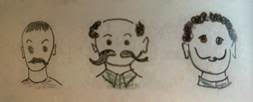
Mom loved history and writing and published her works on family and the Middle East at Howe About Books. The first, All About US in the Middle East, was for children, featured simple, loving drawings on every page, and was told through the eyes of her oldest son, 7 years old when we arrived in East Jerusalem in January 1967.
A sense of adventure sent her traveling to find her place in life after graduating from the University of Texas (1955). She worked in New York City and then sea fared over the Atlantic. During the Cold War, generations of Americans and their families would serve in Europe, charged with protecting a newly reshaped world order—until then rooted in intra-European competition and colonialism—from predatory and expansionist authoritarianism. In that place and time my Mom met my Dad, a U.S. Army officer.
A decade later, Mom brought our family with four children to the Middle East, where my Dad was seconded to the UN Truce Supervisory Organization. From January 1967 to November 1969, we lived in East Jerusalem’s YMCA; the West Bank village of Beit Hanina; Tiberius, Israel by the Galilee; and Beirut, Lebanon, the “Paris of the Middle East”—a place and time that opened Mom’s eyes to the reshaping of another regional order.
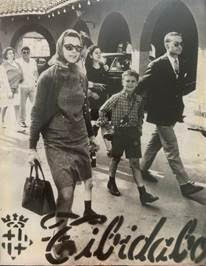
Newly independent Arab states were navigating a path they saw as perched between liberty and security, while Western-backed Zionism grew within the British Mandate of Palestine, emerging as Israel in 1948. During this time, through to our first year in Palestine, Israel forcibly displaced more than a million Palestinians in the Nakba (catastrophe) of 1948 and the Naksa (setback) of 1967.
We were kids; our Mom experienced these events and the people affected in a range of personal ways. In her Middle East series for children, she gave us simple meanings without dwelling on politics, except the obvious. Personal connections came from talking to George, one of the Palestinian waiters who served our breakfast—he called my brother Bruce “Mr. Cornflakes”—at the YMCA in Jerusalem. Insight came from talking to the Jordanian officer who warned us he could still see light—which could facilitate aerial targeting by Israel–shining through the blackout curtains of our West Bank apartment in the days before the 1967 war.
George and other waiters at the YMCA, 1967
Mom was responsible for evacuating our family to Rome—Dad, as a UN observer, remained in the Jerusalem area—in early June and bringing us back after the war. We had many more memories than space permits, but these vignettes represent events we discussed multiple times in the decades since. They reflect her perspective of a new regional order—anchored on Israel’s security and backed by America with little if any regard for the policy implications on Arabs and others in the region.
- Disapproval of the “men with guns” in Israel waving down civilian vehicles for a ride, a jarring reality that reflected a cocky post-1967 militarism.
- A sensibility for justice offended by Israel’s razing of the Maghrebi (Moroccan) quarter in June 1967, immediately after its conquest of Jerusalem; it forcibly displaced hundreds of Palestinians to make way for the Western Wall plaza.
- Witnessing from our apartment a dozen civilian Lebanese aircraft burned by Israel in December 1968 at Beirut International Airport in “retaliation” for earlier PFLP attacks. This personalized subsequent decades of such Israeli reprisals against civilians, especially in Lebanon, Gaza, and the West Bank.
- Routine use of the phrase “all planes returned safely to base”—until Gaza—as reassurance after completion of air travel. We’d routinized this phrase from Israeli radio, where it was unfortunately a reflection of Israeli’s reliance on punitive airstrikes.
As a result of such experiences, Mom understood the ethnosectarian power dynamics in Palestine. For instance, her second children’s book, More About Us in the Middle East, recognized Israel’s 1968 National/Independence Day with her touching drawing of a Jewish boy holding an Israeli flag along with the notification that, “Even now, the Palestinian people continue to struggle under cruel conditions of the Occupation.”
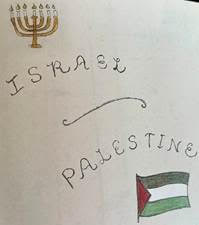
Such observations of unfairness by our Mom—injustice I was blind to until after conscientious study and reflection on my numerous disagreements with her–ultimately led me to recognize the source of our different understandings. The dominant narrative in America favors Zionism; the Establishment has for too long privileged the lives and narratives of Israeli Jews over others.
While Mom encountered Palestine/Israel as a conscientious adult, I was a boy; when we returned to America, everything I read in the mainstream media reshaped my understanding of what I experienced, explaining away the injustice and oppression as the legitimate security needs of ordinary Israelis.
The wake-up call for me—to resolve the cognitive dissonance between my eyes and what I read in mainstream media—came from Dana Howe on Palestine.
Our Mom often spoke about the principles of fairness that should guide our lives. Her views were intense—she grieved injustice in America and in the Holy Land–and she was not shy about expressing judgment. Fittingly, Psalm 10 will be read at her funeral service on April 11 in Richmond; all are welcome. Excerpts:
Why, Lord, do you stand far off? Why do you hide yourself in times of trouble?
In his arrogance the wicked man hunts down the weak, who are caught in the schemes he devises…
He lies in wait near the villages; from ambush he murders the innocent. His eyes watch in secret for his victims…
He says to himself, “God will never notice; he covers his face and never sees.”
Arise, LORD! Lift up your hand, O God. Do not forget the helpless…
You, LORD, hear the desire of the afflicted; you encourage them, and you listen to their cry,
defending the fatherless and the oppressed, so that mere earthly mortals will never again strike terror.
Your dutiful son,
Kirk


Leave a comment