At its heart, the Christmas story is about the arrival of a new era.
In the Christian narrative, Jesus was born in Nazareth in Palestine to herald a new kingdom on earth in which love and justice would prevail. It would bring true peace in which all are participants.
Christmas is a time to celebrate these possibilities…but on Palestine we’re still waiting.
We’re waiting for new ideas of living together to replace the old, in which one people claimed supremacy and sought to replace another people. For the new to arrive the old must pass.
Zionism is “the old.” There are two ways to think about replacing it. One is confronting it and exposing what it’s become. The other—our primary role given that we live in society imbued even subconsciously with values that privilege Israeli Jewish lives—is to challenge and educate ourselves.
Several years ago, resolved by the murder of George Floyd to “do something,” I took the Episcopal Church’s Sacred Ground course on racism in America, racism that subconsciously imbued our society, privileging the lives of Whites above others. The course was an awakening, but its primary lesson was that our most important action is not to “do something” outwardly, such as social action, but to invite change inwardly, transforming ourselves.
Soon after October 7—when it was already clear that Israel’s response would exceed its typical (racist-framed) “mowing the grass” military operations but before “genocide” was the widely understood description of its actions in Gaza—I attended a public, interfaith discussion of Antisemitism and Islamophobia at a nearby synagogue.
Like many, I was puzzling over the relationship of Zionism and Judaism and saw that critics of Israeli actions sought to distinguish the two. A supremacist, land-claiming ideology that elevated the state as an end and envisioned clearing indigenous people as a means is vastly different from a religion that reveres God and God’s teachings, and that recognizes the value of human life is so great that each person is a universe in itself.
Yet when I framed my question to the rabbi, on the panel to discuss Antisemitism—asking whether she recognized that critics of Israel distinguish Zionism from Judaism to prevent antisemitism–she rebuked my question as an affront to her Judaism, in effect insisting that Zionism could not be questioned.
Her defensiveness didn’t prove my point, though the distinction between faith and political ideology is manifestly obvious. But it highlighted something more broadly important about the Palestine-Israel struggle centering on the narrative: what is the meaning of what is happening—why and what are the moral lessons? –and most importantly, who can narrate.
The struggle inside Israel-Palestine—and in the region immediately beyond that’s within reach of Israel’s U.S.-provided combat weaponry–is mostly decided by force and by facts on the ground: military dominance, ethnic cleansing, and settlement expansion. But it’s the moral struggle over the narrative and who controls it—a debate that takes place mostly outside Palestine-Israel–that will decide the content and character of the new era.
And our first responsibility in this advent time is self-transformation.
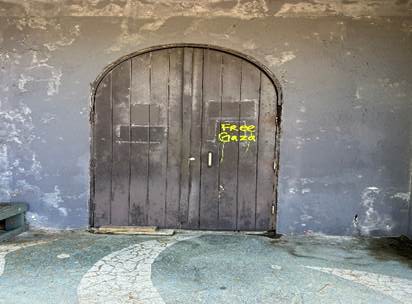
This picture is from Puerto Rico in early December and was taken in Luis Munoz Rivera park. LMR was a poet and struggler for Puerto Rican autonomy from Spain.
 iqraadc.org
Leave a comment