Saturday morning in Minneapolis was hard to take because we love our country. For the community that fights untruths and indifference to seek justice for Palestine, ICE brutality and MAGA community support for it is unsettlingly familiar.
This familiarity comes from decades of witnessing oppression in Israel-Palestine, the images and sound bites of which reverberate in America as echoing shocks in recent years, climaxing—for the moment–on January 24.
“We wake with

no words, just woe

 & wound. Our own country shoot

ing us in the back is not just brutal

ity; it’s jarring betrayal; not enforcement,

 but execution. A message: Love your people & you

 will die. Yet our greatest threat isn’t the outsiders

 among us, but those among us who never look

 within. Fear not those without papers, but those

 without conscience. Know that to care intensively,

 united, is to carry both pain-dark horror for today

 & a profound, daring hope for tomorrow. We can feel

 we have nothing to give, & still belove this world wait

ing, trembling to change. If we cannot find words, may

 we find the will; if we ever lose hope, may we never lose our

 humanity. The only undying thing is mercy, the courage to open

 ourselves like doors, hug our neighbor,

 & save one more bright, impossible life.

~Amanda Gorman, For Alex Jeffrey Pretti (2026)
Meanwhile, the everyday prose of social and political life that was our custom—friendly or heated debates over the meaning of events and the appropriate policy response—have evolved since January 6, 2021, into often righteous anger over disagreement on basic facts.
One theory of how this happened is that for too long there’s been a lack of integrity in the morality Americans believe we bring to the world. We proclaim in favor of freedom and equality–universal rights. Our actions often belie our words. Nowhere is the dual standard more manifest than on Israel-Palestine.
Why it matters
Both U.S. political parties, but especially the Democrats—who for decades claim to stand with integrity for such universal values as justice and equality—reveal a moral core hollowed by this dual standard. How much more difficult it is then to face down the lies of January 6 and after, when their MAGA purveyors throw them back, alleging hypocrisy.
In addition, the Democratic party is needlessly weakened—an own goal—by internal division between progressives who believe that everyone is equal and “progressives except on Palestine” (PEP) who make exception for Zionism, which privileges Israeli Jewish lives and narratives over all others.
Belief in the universality of equal rights is not radical, but PEP and our society more broadly treat it as such regarding Palestinians. If you doubt this, try insisting publicly on Palestinian rights and freedom at work or school or places of worship the way you might for Ukraine or against antisemitism. Results may vary—“why this bias?” … ”that’s too political” … “do you support Hamas?” or “that’s not appropriate for this campus”—but are generally not welcoming.
Nevertheless, a united progressive movement, whether that’s the Democratic party or something else, is not possible until progressives truly unite and act with integrity around our core moral values.
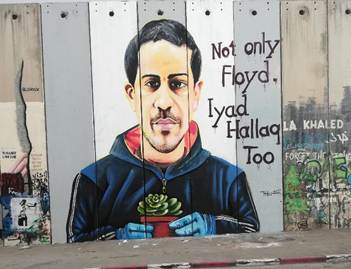
Separation Wall with image by Lushsux; honors Palestinian Iyad Hallaq, killed by Israeli police
in Jerusalem the week Minneapolis police killed George Floyd.
America and Israel-Palestine
After Israel’s 1967 war victory, America became Israel’s primary strategic patron, succeeding Britain and France. Ties became so close that Israel could rely on the US readily vetoing and hollowing UNSC resolutions critical of occupation, settlement building, and military aggression, and US condemnation or counterefforts on UNGA actions favorable to Palestine or that described Zionism as racism. Meanwhile, Americans celebrated Israeli leaders such as Prime Minister Golda Meir—the most admired woman in America in 1974, according to Gallup—who declared in 1969, “there was no such thing as Palestinians.”
Inside Israel, the political seeds of thought that justified the 1948 Nakba (Catastrophe)—driving 750,000 Palestinians from their homes—bloomed with the military occupation in 1967. The Jewish population dominated by Labor Zionism during initial immigration and the founding of the state turned steadily rightward after the 1967 war. Israel began building settlements even before the September 1967 Arab summit’s “three No’s.” By 1977, with settlement building under way for a decade—beginning in Syria’s Golan in July 1967—but growing in the West Bank, Gaza, and East Jerusalem too, the right-wing Likud replaced Labor as the dominant force in Israeli politics.
Over the decades, America directly linked both our strategic and moral outlook and our policy thinking for the region to inherently racist Israeli policies, which were implemented both inside Israel and in the occupied territories. “Racist” because only racism—whether latent and subtle or overt, cruel, and brutal—could underpin the open-ended subjugation by one people of another.
Thus, the same ‘the moral underpins the political’ dynamics that drove American slaveholding to result in Southern secession and the Civil War, have also led Israel’s occupation to result in what genocide scholars (and South Africa’s 2023 case at the ICJ) allege is genocide in Gaza. Problematically—shamefully, for the conscientious—whether Israel’s behavior is genocide or some other immoral epithet, the crisis is ongoing with worsening conditions now in the West Bank, while America continues to support Israel—financially, militarily, politically, strategically.
In an earlier moment like the one that moved Amanda Gorman, our former National Youth Poet Laureate, Mahmoud Darwish—the Palestinian national poet—wrote of Gaza. And note (as reflected in the date), that what’s happening to Gaza has happened for decades.
“Gaza has no throat. Its pores are the
ones that speak in sweat, blood, and
fires. Hence the enemy hates it to
death and fears it to criminality, and
tries to sink it into the sea, the
desert, or blood. And hence its
relatives and friends love it with a
coyness that amounts to jealousy
and fear at times, because Gaza is
the brutal lesson and the shining
example for enemies and friends
alike.
~Mahmoud Darwish, excerpt from Silence for Gaza (1973)
Today’s moment reflects our history at home and abroad, and it calls for integrity, both to purify our message and to unite us around it. For unity can bring what Gore foresaw as “profound, daring hope for tomorrow.”
 iqraadc.org
Leave a comment