A couple of administrative announcements, then an alum’s efforts in Gaza (you can help), and our main message on running in heat.
To create your fundraising page (it is time): Choose “be a fundraiser” and “as individual” at this link: https://act.upaconnect.org/campaign/support-team-iqraa-2026/c771208
Thanks to Imad and Norman for volunteering for two of our four hosting dates during the next 6 weeks. If you can feed the runners at our Aug 1 or Aug 29 training runs, please raise your hand!
Orphans in Gaza need help. Iqraaphile and alum Mai Abdul Rahman spoke at Hikayet Watani (Story of my Homeland; thanks to Salma for organizing!), a pro-Palestine event in Adams Morgan, on Saturday and graciously invited me to talk briefly about Iqraa, a boon as we’re still recruiting runners. Thanks, Mai!
- Before founding Iqraa in 2008, Mai was the first person I talked to; it was her idea to suggest our name. Understanding that our focus would be on education, she suggested we call ourselves “Iqraa” (Read!). Iqraa is the first word of the Angel Gabriel’s first revelation to Mohammed in the sura Al ‘Alaq (The Clot).
- At Saturday’s event, Mai spoke about Americans For Palestinian Orphans (A4PO), which serves orphaned children 5 to 13 years old in Gaza, crucially providing shelter, healthcare, and learning.
- To learn more and/or provide financial support (A4PO is a 501(c)3): www.a4po.org
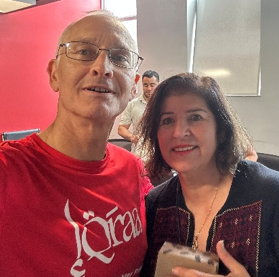
We’ve had severe heat recently and expect more; it’s time to discuss running in heat. Here are 10 good tips drawn from Thad McLaurin’s article on the MCC website (week 4 training articles)
1.Acclimatize. One way to do this is by cutting back on the intensity of your run—the article recommends by 65 to 75 percent—and then gradually building it back up. Start extra slow!
2. Check the Index. Meaning the air quality index. Be extra cautious during Code Orange (slow down; run in shade) air quality. Don’t run at all in Code Red (150+ AQI). Instead, cross train indoors!
3. Hydrate! Begin before the run and hydrate regularly, not just when you’re thirsty. Drink electrolytes NLT one hour into a run. Wear or carry fuel, e.g. handheld, fuel belts & camel backs!
4. Know the Warning Signs. Dehydration is accompanied by muscle cramps, feeling faint, nausea, vomiting, heart palpitations, and lightheadedness. If you feel even a little queasy, stop and take a break!
5. Buddy Up. In severe heat, be sure to run with a buddy, so you can keep tabs on each other. And honestly, if it’s truly severe, see the next tip (#6), find a shady course (#8), or postpone your run (#2).
6. Run Early. Run in the early morning to avoid the hottest part of the day. Heat typically peaks around 5 p.m. That’s why we run at 7 am, and some of you start even earlier. Zaki (smart)!
7. Go Technical. Light-colored technical fabrics will keep you cool(er) and allow moisture to evaporate more quickly. Examples include Lycra, Nylon, CoolMax, and Dry-Fit.
8. Change Your Route. Run in the shade! My unscientific body thermometer tells me it’s 10 to 15 degrees cooler in the shade and my morale is boosted by twice that. In really bad heat, see #2!
9. Lather it on. Research shows that runners have a higher rate of skin cancer, probably because we’re outside more than the average person, and wearing less clothing. Wear a sport sunscreen!
10. Have a Plan. Make sure someone knows your running route, especially when it’s extra hot. You may want to pack your cell phone too, along with lots of fluids. Be safe!
Here are additional MCC articles on running in the heat:
- Week 2: https://mc-coop.org/stp/weekly-training-articles/10-essential-tips-for-running-and-racing-in-the-summer-heat/
- Week 3: https://mc-coop.org/stp/is-training-in-the-heat-good-for-you/
- Week 7: https://mc-coop.org/stp/what-you-should-know-about-heat-illness-and-exercise/
Last week/this week: I’ve been neglectful regarding team pictures lately but will try get one this Saturday in Reston, where the distances are 13 miles for marathoners and 6 for half-marathoners. Last week at Columbia Island Marina we had a good turnout, including Alejo, Bill, Cathy, Imad, Mazen, Shobila, Tyler, and me.
Friends, in closing, one of the most important things Coach Nick teaches—and it applies to life as well as running—is to have a plan you can follow when the going gets tough, as it inevitably does.
- In the heat, the plan can be as simple as carrying your own water and slowing your pace.
- Having a plan—and following it—means you are in still in the saddle. Yes, we need to accept that many outcomes are possible, but in a struggle, the confidence that you know how to get through is huge emotionally.


Leave a Reply