Saturday morning in Minneapolis was hard to take because we love our country. For the community that fights untruths and indifference to seek justice for Palestine, ICE brutality and MAGA community support for it is unsettlingly familiar.

This familiarity comes from decades of witnessing oppression in Israel-Palestine, the images and sound bites of which reverberate in America as echoing shocks in recent years, climaxing—for the moment–on January 24.  

“We wake with

no words, just woe

& wound. Our own country shoot

ing us in the back is not just brutal

ity; it’s jarring betrayal; not enforcement,

but execution. A message: Love your people & you

will die. Yet our greatest threat isn’t the outsiders

among us, but those among us who never look

within. Fear not those without papers, but those

without conscience. Know that to care intensively,

united, is to carry both pain-dark horror for today

& a profound, daring hope for tomorrow. We can feel

we have nothing to give, & still belove this world wait

ing, trembling to change. If we cannot find words, may

we find the will; if we ever lose hope, may we never lose our

humanity. The only undying thing is mercy, the courage to open

ourselves like doors, hug our neighbor,

& save one more bright, impossible life.

~Amanda Gorman, For Alex Jeffrey Pretti (2026)

Meanwhile, the everyday prose of social and political life that was our custom—friendly or heated debates over the meaning of events and the appropriate policy response—have evolved since January 6, 2021, into often righteous anger over disagreement on basic facts.  

One theory of how this happened is that for too long there’s been a lack of integrity in the morality Americans believe we bring to the world. We proclaim in favor of freedom and equality–universal rights. Our actions often belie our words. Nowhere is the dual standard more manifest than on Israel-Palestine.

Why it matters

Both U.S. political parties, but especially the Democrats—who for decades claim to stand with integrity for such universal values as justice and equality—reveal a moral core hollowed by this dual standard. How much more difficult it is then to face down the lies of January 6 and after, when their MAGA purveyors throw them back, alleging hypocrisy.

In addition, the Democratic party is needlessly weakened—an own goal—by internal division between progressives who believe that everyone is equal and “progressives except on Palestine” (PEP) who make exception for Zionism, which privileges Israeli Jewish lives and narratives over all others.

Belief in the universality of equal rights is not radical, but PEP and our society more broadly treat it as such regarding Palestinians. If you doubt this, try insisting publicly on Palestinian rights and freedom at work or school or places of worship the way you might for Ukraine or against antisemitism. Results may vary—“why this bias?” … ”that’s too political” … “do you support Hamas?” or “that’s not appropriate for this campus”—but are generally not welcoming.

Nevertheless, a united progressive movement, whether that’s the Democratic party or something else, is not possible until progressives truly unite and act with integrity around our core moral values.
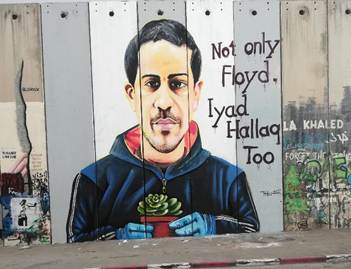
Separation Wall with image by Lushsux; honors Palestinian Iyad Hallaq, killed by Israeli police

 in Jerusalem the week Minneapolis police killed George Floyd.

America and Israel-Palestine

After Israel’s 1967 war victory, America became Israel’s primary strategic patron, succeeding Britain and France. Ties became so close that Israel could rely on the US readily vetoing and hollowing UNSC resolutions critical of occupation, settlement building, and military aggression, and US condemnation or counterefforts on UNGA actions favorable to Palestine or that described Zionism as racism. Meanwhile, Americans celebrated Israeli leaders such as Prime Minister Golda Meir—the most admired woman in America in 1974, according to Gallup—who declared in 1969, “there was no such thing as Palestinians.”

Inside Israel, the political seeds of thought that justified the 1948 Nakba (Catastrophe)—driving 750,000 Palestinians from their homes—bloomed with the military occupation in 1967. The Jewish population dominated by Labor Zionism during initial immigration and the founding of the state turned steadily rightward after the 1967 war. Israel began building settlements even before the September 1967 Arab summit’s “three No’s.” By 1977, with settlement building under way for a decade—beginning in Syria’s Golan in July 1967—but growing in the West Bank, Gaza, and East Jerusalem too, the right-wing Likud replaced Labor as the dominant force in Israeli politics.

Over the decades, America directly linked both our strategic and moral outlook and our policy thinking for the region to inherently racist Israeli policies, which were implemented both inside Israel and in the occupied territories. “Racist” because only racism—whether latent and subtle or overt, cruel, and brutal—could underpin the open-ended subjugation by one people of another.

Thus, the same ‘the moral underpins the political’ dynamics that drove American slaveholding to result in Southern secession and the Civil War, have also led Israel’s occupation to result in what genocide scholars (and South Africa’s 2023 case at the ICJ) allege is genocide in Gaza. Problematically—shamefully, for the conscientious—whether Israel’s behavior is genocide or some other immoral epithet, the crisis is ongoing with worsening conditions now in the West Bank, while America continues to support Israel—financially, militarily, politically, strategically.  

In an earlier moment like the one that moved Amanda Gorman, our former National Youth Poet Laureate, Mahmoud Darwish—the Palestinian national poet—wrote of Gaza. And note (as reflected in the date), that what’s happening to Gaza has happened for decades.

“Gaza has no throat. Its pores are the

ones that speak in sweat, blood, and

 fires. Hence the enemy hates it to

 death and fears it to criminality, and

 tries to sink it into the sea, the

desert, or blood. And hence its

 relatives and friends love it with a

 coyness that amounts to jealousy

 and fear at times, because Gaza is

the brutal lesson and the shining

 example for enemies and friends

 alike.

~Mahmoud Darwish, excerpt from Silence for Gaza (1973)

Today’s moment reflects our history at home and abroad, and it calls for integrity, both to purify our message and to unite us around it. For unity can bring what Gore foresaw as “profound, daring hope for tomorrow.”
At its heart, the Christmas story is about the arrival of a new era.

In the Christian narrative, Jesus was born in Nazareth in Palestine to herald a new kingdom on earth in which love and justice would prevail. It would bring true peace in which all are participants.

Christmas is a time to celebrate these possibilities…but on Palestine we’re still waiting.

We’re waiting for new ideas of living together to replace the old, in which one people claimed supremacy and sought to replace another people. For the new to arrive the old must pass.

Zionism is “the old.” There are two ways to think about replacing it. One is confronting it and exposing what it’s become. The other—our primary role given that we live in society imbued even subconsciously with values that privilege Israeli Jewish lives—is to challenge and educate ourselves.

Several years ago, resolved by the murder of George Floyd to “do something,” I took the Episcopal Church’s Sacred Ground course on racism in America, racism that subconsciously imbued our society, privileging the lives of Whites above others. The course was an awakening, but its primary lesson was that our most important action is not to “do something” outwardly, such as social action, but to invite change inwardly, transforming ourselves.  

Soon after October 7—when it was already clear that Israel’s response would exceed its typical (racist-framed) “mowing the grass” military operations but before “genocide” was the widely understood description of its actions in Gaza—I attended a public, interfaith discussion of Antisemitism and Islamophobia at a nearby synagogue.

Like many, I was puzzling over the relationship of Zionism and Judaism and saw that critics of Israeli actions sought to distinguish the two. A supremacist, land-claiming ideology that elevated the state as an end and envisioned clearing indigenous people as a means is vastly different from a religion that reveres God and God’s teachings, and that recognizes the value of human life is so great that each person is a universe in itself.

Yet when I framed my question to the rabbi, on the panel to discuss Antisemitism—asking whether she recognized that critics of Israel distinguish Zionism from Judaism to prevent antisemitism–she rebuked my question as an affront to her Judaism, in effect insisting that Zionism could not be questioned.  

Her defensiveness didn’t prove my point, though the distinction between faith and political ideology is manifestly obvious. But it highlighted something more broadly important about the Palestine-Israel struggle centering on the narrative: what is the meaning of what is happening—why and what are the moral lessons? –and most importantly, who can narrate.

The struggle inside Israel-Palestine—and in the region immediately beyond that’s within reach of Israel’s U.S.-provided combat weaponry–is mostly decided by force and by facts on the ground: military dominance, ethnic cleansing, and settlement expansion. But it’s the moral struggle over the narrative and who controls it—a debate that takes place mostly outside Palestine-Israel–that will decide the content and character of the new era.

And our first responsibility in this advent time is self-transformation.

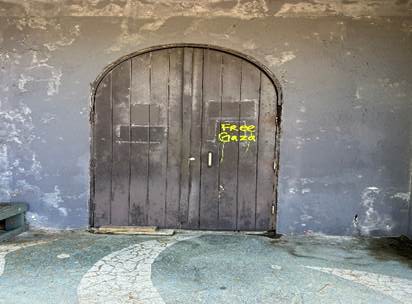
This picture is from Puerto Rico in early December and was taken in Luis Munoz Rivera park. LMR was a poet and struggler for Puerto Rican autonomy from Spain.


My Mother Once Said

I will recognize you by your voice,

by your prayers

for me and for the martyrs.

I will not lose my way in the darkness,

for the fires of their hatred

have lit up the sky.

Oh, mother,

You lied, mother,

You lied for me and to yourself,

And for a homeland you loved.

But no one loved us,

Oh, mother,

No one loved us,

Except God.

~Nour Khalil AbuShammala, June 2024

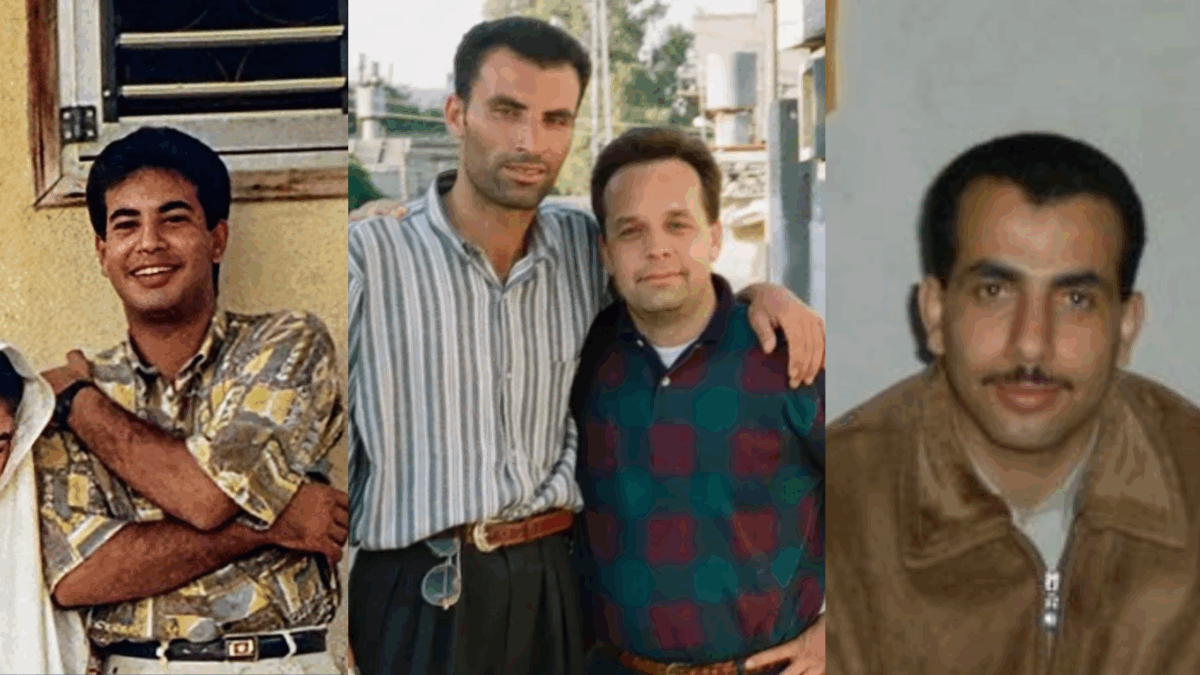
Nour is the daughter of Khalil, one of three central figures in No Way But Forward by Brian Barber, a story of 3 Palestinian men and their families in Gaza over a 45-year period. (https://bkbarber.com/books/)  

  •  As Iqraa 21 highlighted, through its focus on Brian’s book, education is central to Palestinian identity. Nour’s writing—essays and poetry—reflect this.

Education is both a central part of the Palestinian dream and a cherished and hard-earned resource of the Palestinian people. The wealth of Palestinian human capital—derived from education–is the foundation of Palestine’s eventual liberation.

  • As Nour said (The Electronic Intifada (TEI), 21 February 2024), “I studied law for four years and trained for two years…A week before this genocide started, I passed the bar exam. I was hoping to pursue a master’s degree in international humanitarian law before the occupation destroyed my life, dreams and hopes…Despite all our blood, wounds, pain, all I want is my homeland and my home.”

Nour’s young life reflects her love for education; she has been able to make her voice heard in the West largely because of it. She earned a law degree from Al Azhar University in Gaza university in 2021 and has worked for the Palestinian Centre for Human Rights in Gaza, which monitors and documents the practices of Israeli military forces in Gaza and the West Bank, according to its website. In addition, Nour has published poems and essays in a variety of Western media, e.g. Nour in LA Times.

As Nour says (TEI), “Stop this war before you kill our hope. Stop it and return us to our homes, because we deserve a decent life. Or, return us to our homes and kill us there, as I don’t want to die in a tent.”

Both poems in this Iqraa message appeared in No Way But Forward, and were made available to Brian by Nour’s proud father, Khalil.

The Land Fights, Too

The earth yields its fruits,

Defying siege and hunger,

Defying the occupation.

Tomatoes sprout,

Peppers and eggplants,

Despite cut-off water,

Despite forbidden shells.

Mint and basil’s fragrance wafts,

The scent of homeland

In The land of peace.

Despite the tents’ heat,

Children’s displacement,

The loss of dreams,

The earth yields its fruits,

Feeding its children,

North and south,

Refusing starvation.

The earth brings forth vegetables,

And fruits,

Watered by martyrs’ blood.

It fights with its soil,

Holding warriors’ remnants,

Steadfast in death,

Defying forces,

Defying weapons.

Our people plant,

And eat from our land’s soil.

The earth fights side by side,

With its sea, with its brave resisters.

It grows patience,

Quelling children’s hunger,

Silencing mothers’ tears,

Easing men’s burdens.

Only in Gaza,

The earth fights with its people.

~Nour Khalil AbuShammala, July 2024

They will recognize us by our voice. 


First, thanks again to Bill for hosting last Saturday, and with a nice variety of savory and sweet.

  • Iqraa hosted 8 runs this year, plus an aid station at the MCC 20-mile training run. All possible, thanks to the generosity of Basel, Basma, Bill, Cathy, Shobi, Siva, and me!

And now it’s MCM week: challenge accepted by Cathy, Bill, and Reza!

And some MCM day thoughts from a bird’s eye:

  • Gratitude. We’re blessed in so many ways to enjoy the physical and emotional freedom to run. Most people for a variety of reasons can’t dream of what you’ll do this weekend.
  • ·        Enjoyment. If you’re looking for a PR, go for it! But don’t let that stand in the way of taking in the experience and enjoying the return on your investment in the training program.  
  • ·        Goodness. Use your run for good. Running for a brighter Palestine makes the miles meaningful. Palestinians need our support more than ever.

Friends, the training year is ending. We hope you’ll stay for the Winter Runs—let me know to sign you up. It’s a more informal program: free miles, no frills.  

  •  In December we’ll have an Iqraa dinner at Mama Ayesha’s; keep an eye out for the date.

Even so, we keep Palestine in mind and in our prayers.

  •   Don’t ever feel discouraged. If you take action, you’re making a difference.  

There’s much you can do to help. The links below are just a small part of what you can do:

  •  The Arab American Institute organizes Arab-Americans into an effective constituency for all aspects of civil life. Arab American Institute (aaiusa.org)
  • ·        The Council on American Islamic Relations, founded to advance Muslim civil rights in America. https://www.cair.com/
  • ·        Churches for Middle East Peace is a collective of more than 30 national-level churches that promotes conflict resolution, especially on Israel-Palestine. https://cmep.org/
  • ·        Jewish Voice for Peace, the world’s largest Jewish organization supporting Palestine (with all their hearts, I’d add). https://www.jewishvoiceforpeace.org/
  • ·        Providing resources to the US-based Palestine solidarity movement, US Campaign for Palestinian Rightshttps://uscpr.org/
  • ·        Palestine Legal protects the civil and constitutional rights of those supporting Palestinian rights. https://palestinelegal.org/
  • ·        United Palestinian Appeal empowers Palestinians in health, education, community, and socioeconomic development. https://upaconnect.org/
  • ·        Iqraa, Running for a brighter Palestine since 2008 (share with friends). https://iqraadc.org/
    • We’ve raised more than $28,000 and need your contribution to surpass $30,000—30 scholarships: UPA Team Iqraa 2025

Last week/this week. Last Saturday at Candy Cane City, Bill, Cathy, Peter, Reza, Basel, and I ran or walked 8 miles. This Saturday at Camp Rosslyn, we’ll do our last organized run together in 2025.

My greatest wish for this group is to see you all again regularly, running for a brighter Palestine!


First, let’s thank Basel for hosting last Saturday’s run. Nick called it one of the best training-run brunches he’s had. Alf shukr wa shukr! (1001 thanks!)

Appreciation also for those who’ve created your fundraising pages. And I know several of you are drafting your letters too. Here’s the link for those who need to make a page and those who want to contribute:

Listen, I know that fundraising isn’t anyone’s favorite activity, and I understand that some feel there’s an ‘ayb (shame) in asking anyone for anything.

But let’s take a look around… there’s a genocide in Gaza that includes the destruction of virtually all educational infrastructure. Here in America, there’s suppression against those who speak out for Palestinian equality.  

These injustices cannot stand! …But injustice won’t just collapse and go away. Only action will bring change. “If not us, who? If not now, when?” (Rabbi Hillel; born in Babylonia, now Iraq, 1st century BCE)

Remember this, friends: we’re not asking anyone to help US.

We’re asking people to help provide Palestinians with an education because in doing so we’re asserting the equal right of Palestinians to be educated.  And we’re not going to stop. Education toward liberation!

Here’s the potential—and the power when we act—of our outreach:

  • Americans—our potential sponsors—need to know what’s happening in Palestine
  • Americans—our potential helpers—need to know what they can do
  • Palestine is not going to brighten itself: we’re running for a brighter Palestine. That’s an active verb, a transitive action
  • Education isn’t free but we can help provide it to those who might never afford it through our fundraising efforts
  • Palestinians are alone unless we help them. I know you all want to help. Don’t let yourself be restrained by inhibition about asking.

Last week/this week. Last Saturday at Columbia Island, Basel hosted and Cathy, Reza, and Imad (not pictured) ran while I walked. This Saturday, we’re running in Reston; 12 miles for marathoners and 8 miles for half-marathoners.

Running toward a future bright with a liberated Palestine and a truly equal America.


I often look for fresh insights to the importance of education and ways to highlight to fellow Americans the equal humanity of Palestinians. Fortunately, Brian Barber’s book, No Way But Forward: Life Stories of Three Families in the Gaza Strip (2025) provides both.

  • A theme throughout, and reflective of Palestinian culture, is that education is as at least as important in Gaza as any place in the world you might imagine. In comparison to more privileged communities, education is recognized from an early age as a foundation for the future and an opportunity provider.

Before we go to the biographical summaries (picture attached), here’s a link for those who want to see the author’s website and/or order No Way But Forwardhttps://bkbarber.com/books/

Hammam Faqawi. We first meet Hammam–who goes on to becomes a teacher like his father, Fuad, and then a headmaster, earning a Master’s degree at Al-Azhar University in Gaza—when he’s 5 years-old (1980). His mom—Fatima—readies him for the first day of kindergarten:

  • a crucial day, as it was for every Palestinian child. In a culture that regards education as vital, it was ‘the first step of the ladder of the life,’ as the saying goes.”

Two weeks after October 7, 2023, Hammam chances upon his student, Mahmoud, displaced from Gaza City and living in a school.

  • The young student says: “You will come to teach us again. There are many students from our school in Gaza [City] but we lost the books. We came from Gaza with only our clothes on…many of the students of our school said their homes were bombed…and some were pulled out in pieces from under the rubble.”
  • Mahmoud’s little brother also recognizes Hammam: “you are the teacher who teaches Mahmoud…Come on, come to the school. We now live there. Come and teach us there.” Hammam cried, understanding that the “child wants to learn even in these very, very difficult circumstances. This child conveyed to me, with the innocence of childhood, that knowledge is a message and there is a future.”
  •  April 2024, Hammam texted Brian: “Now a new suffering has begun…I want to provide an opportunity for education for children…Everything is destroyed…There is no education. No universities, and no future for the children. For the first time in my life, I feel helpless. I want to change my children’s lives. I want them to learn.”
  • July 2024: “My kids are asking me questions I can’t answer. They are asking about their future. They’ve lost one year of learning, and the second will start soon.”  
  • December 2024. Hammam’s brother Hani is severely injured but survives an Israeli missile strike while driving his Save the Children car.   

Khalil Abu Shammala. Khalil and his siblings received an education in morality and community at their mother—a refugee from Barbara in present-day Israel—Tammam’s knee, in addition to their formal schooling. Khalil went on to become the Exec. Dir. of the Gaza-based Al-Dameer human rights organization from 1998 to 2014.

  • The impact of education on Khalil, including “the Academy of the Palestinians” (prison) was lifechanging:
    • “If the naivete Khalil had always felt had been transformed through his intifada [1987-1993] experiences—his initial detention and subsequent imprisonment—his years as a student political leader while earning his bachelor’s degree in English literature catapulted him into a self-assured young man of twenty-six (1996).
  • Post-October 2023, Khalil’s kids, Nour and Mohammed, graduated from Al-Azhar before October 7, but his daughter Nesma’s computer engineering studies at the same university—she was to have been hired by Google as a web developer upon graduation–were interrupted by Israel’s destruction of Gaza.
  • September 2024. Nour is accepted into a master’s program at the University of Jordan, to study remotely. “She is so happy.” She takes the risk of daily travel to find an internet connection.

Hussam Abushawish. Hussam is 13 when we meet him (1986) and grappling with the dissonance between his grandmother’s assertion that his people were the inhabitants of Palestine/Israel–hailing from Barqa, a few dozen kilometers from Nuseirat in Gaza, where they now lived—and his undeniable reality that Israeli soldiers controlled their lives.

  • Hussam resolves this cognitive dissonance with several months of research, after which he creates a poster board describing the history of Palestine that he places in his classroom. The headmaster quickly makes him remove it, fearful of the consequences should Israeli soldiers discover it, as schools were forbidden from teaching Palestinian history.
  • Two years into the 1st Intifada, when Hussam was 16 (1989), his dad, Fares, gave moral guidance for the future with primacy to education: “…like your mother and I have said before, you must not let your political activity interfere with your studies. Above all else, your education will equip you to serve your people, your cause, our cause. Our struggle will likely go on for a long time in the future, so you need to strengthen yourself with the knowledge and skills that education will provide.”
  • Post-October 2023, Hussam’s brother Omar was killed while returning home from a daily jog on Oct 7. In Hussam’s words, “That missile was the very one that didn’t grant him the  opportunity to continue his pursuit of knowledge, work, and poetry. It robbed him of the chance to embrace fatherhood to a three-year-old daughter named Elena.”
  • May 2024. Hussam’s wife loses a second brother, in addition to two nieces and a nephew during the first 7 months of Israeli airstrikes.

The book’s narrative ends on October 7, 2024, with an epilogue last December 20.  

  • Each family relocated multiple times, returning to the remains of their homes when possible.
  • Their search for food and struggle against disease is constant. The situation now is immeasurably worse. As one of the men says, “there is no bottom in Gaza.”
  • None of them would voluntarily leave Gaza. But they want their children to have a better life.

Last week/this week. Last Saturday at Carderock, Basel and Reza ran 20 miles, as did Cathy in Minnesota, while Basma ran 10, and Mazen and Jorge walked 8 and ran 6, respectively. This Saturday, we’re running at Columbia Island Marina—everyone is running 12 miles. 

And shout out to Basel for stepping up to host!

No way but forward to a brighter Palestine.


This week’s message highlights a Palestinian whose life story epitomizes decades of the very incomplete struggle for justice for Palestine…and underscores the need to hold fast to “radical” equality–radical meaning simply that we won’t settle for less.

First, three public service announcements…

  •  Remaining host dates for Iqraa are Aug 30, Sept 20, Oct 4, and Oct 18 (Basma). Let me know if you can help!
  • Field trip to Museum of the Palestinian People: Aug 23 at 1 pm. Inshallah, the new Iqraa jerseys will be available for a shirt-museum twofer.
    • Museum address: 1900 18th St NW, Washington DC 20009  
  • Here are the UPA-supported universities—with our significant (48 scholarships in 2024) assistance—in the Mahmoud Darwish university scholarship program. Thanks, Tabitha!
    • Gaza: Al-Azhar University and University College of Applied Sciences
    • West Bank: Al-Quds University, An-Najah, Bethlehem University, Birzeit University, Dar al-Kalima, and Palestine Polytechnic
    • Jordan: Al al-Bayt University, Al-Balqa Applied University, Jerash University, Jordan University of Science and Technology, The Hashemite University, the University of Jordan, Jerash University, the World Islamic Sciences & Education University, and University of Petra
  • Last week/this week. Last Saturday at Columbia Island Marina, Basma, Cathy, Basel, Imad, Reza, and me ran or walked (photo) and Cathy talked about the Mental Game. This Saturday we’re at Reston, where marathoners will run 16 miles while half-marathoners run 9.   

Every life has a story and Awdah Hathaleen’s epitomizes so much of the injustice inherent in Zionism’s treatment of non-Jews. In 1948, with 750,000 other Palestinians, Awdah’s (his name means “Return”) grandparents were displaced from the Naqib/Negev to the Masafer Yatta area south of Hebron.

  •  Awdah, born a year after the Oslo Accords—the “two-state solution”—saw his family home demolished periodically for lack of a permit, while the illegal Carmel settlement continuously expands.
  • Awdah was inspired to nonviolent activism by his uncle, Haj Suleiman, a nonviolent activist killed by Israeli police in 2022. Awdah also taught English in the village school so the children could tell their story to the world, according to his cousin, Eid.   
  • Awdah documented settlers’ efforts to displace his family and village, and ultimately filmed his own killing on July 28 at the hands of a settler. The Israeli killer was freed within 3 days, while Awdah’s body was held for 10 days, and not released until the women of his village went on hunger strike, while many of his male relatives were detained.
  • Awdah contributed to the Oscar-winning No Other Land(2025)documentary, made largely of hand-held video that chronicled in fearsome intimacy the settler violence aimed at ethnically cleansing Masafer Yatta.   
  • Awda’s killer, Yinon Levi, was a known threat, sanctioned in 2024 by President Biden, who since October 2023 also ensured an uninterrupted flow of US arms and 7 US vetoes/no’s on Security Council resolutions seeking to constrain Israel’s cruel and deliberate violence in Gaza. Within days of his election, Trump, who campaigned—among many depravities–on deporting pro-Palestine activists, lifted the sanctions on Levi.  

What it means for Iqraa. It’s a salient point, made at dozens of Iqraa info sessions since 2008, that Iqraa is non-partisan: agnostic toward political parties and peace solutions; however, we’re not indifferent toward injustice.

For the many of us who prioritize a brighter Palestine in every arena—not solely through running:

  • We must stand for radical equality—if it’s “radical” to insist that Palestinian lives are equal to those of Israeli Jews—because every person has an equal right to life, freedom, and education.
  • For our moderate progressive friends who understand that racism is wrong: Zionism is racism. It privileges the rights and lives of one only people over all other people.
  • As we oppose racists, we must also oppose Zionists.
  • We needn’t fear offending our Jewish friends because those who are truly moral venerate the sanctity of life instead of worshipping the state of Israel.  
  • “Progressive except on Palestine” is racist and hypocritical. PEP does not take human equality seriously—radically—and progressives cannot selectively oppose racial supremacism.  

As Americans, our primary touchpoint for opposing Israel’s destruction of Palestine is through the tools of American foreign policy. This includes political movements, politicians, and activists. Our allies in this are not Zionists; in fact, they are anti-Zionists.

Running—and working—for a brighter Palestine…with freedom and justice for all.