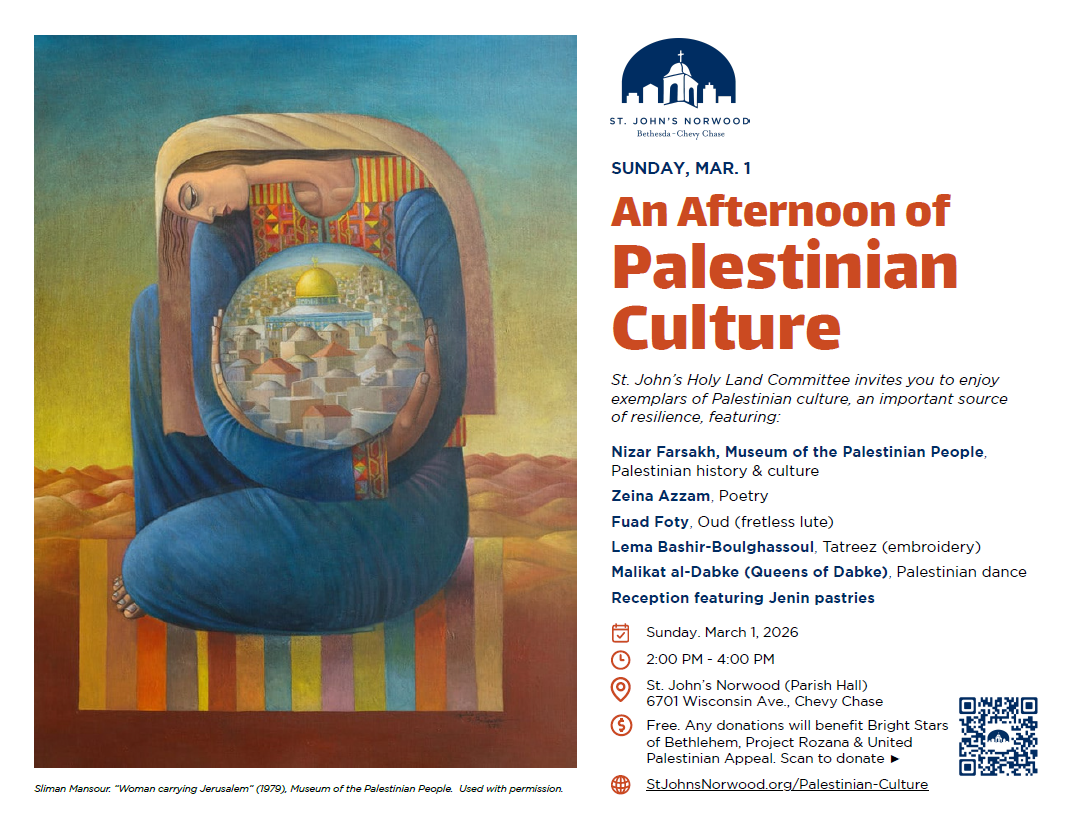
Here’s the link (below) to the Afternoon of Palestinian Culture my church—specifically, our Holy Land Committee—hosted last Sunday. More than 90 people came to see this beautiful event, including many Iqraa sha’b, beginning with our poet laureate, Zeina Azzam, who was one of the featured artists. I told her afterward that I had to bite my lip during some of her poetry; it was painfully real.
Our priest, Sari Ateek, gave the welcome, and other speakers/artists included Nizar Farsakh of the Museum of the Palestinian People; Fuad Foty, who played the oud; Lema Bashir-Boulghassoul, who spoke about tatreez, and Malikat al-Dabke, who danced.
Our reception afterward featured Jenin pastries, and the event raised approximately $3,000 (unofficial total) for Bright Stars of Bethlehem, Project Rozana’s mobile medical clinics, and United Palestinian Appeal.
Another Iqraa alum, Jay Mallin, supported our event, providing the world-class professional A/V recording you see here.
While it’s hard for a single video camera trained on the performers to capture the connection these artists established with the audience, every word, note, step, expression, color, and beat comes through.
Shout out to all our Iqraa alumni who showed out, including Maha and Osama, and their daughter Lena (with a future Iqraa runner), Bill, Bilal, Ramsey and his daughter, Khaled and his wife, Reza, Samar, Sawsan and her husband, Shobi, and as noted, Zeina, Jay, and me. I hope I’m not forgetting anyone.
This was an afternoon filled with love and pride and I’m grateful to share it.
As Spring and the new running season approaches, it’s time to open your calendar and mark down a few dates.
First, this Sunday (March 1) afternoon at my church (2 to 4 pm), we’re hosting a rejuvenating and spirit-building Afternoon of Palestinian Culture. Apologies for scheduling this during the Ramadan fast, but we simply didn’t think enough last October when I discussed this with my church.
The other upcoming events are all running and Iqraa focused (and after Ramadan):
April 18 5k fun run at 0900…still tentative, as UPA seeks to confirm Anacostia Park
· April 22 info session at 6:30 pm…at UPA’s Dupont Circle office (also available by Zoom)
· April 25 info session at 1 pm…at UPA (and via Zoom)
· May 2 training run at 0800…first training run of the year, with Marathon Charity Cooperation, our partners.
We look forward to seeing you all soon. Ya’teek al-‘afiyah!
How rare it is for two Abrahamic religions to coincide on such similar holy days: a period of sacrifice meant to help us appreciate the simple blessings in life—of which there are many—while understanding how fortunate we are.
We do this through fasting or similar sacrifice that compels us to change our routine and reflect on what’s truly important, while considering more seriously the needs of those less fortunate—of whom there are many–and in all this we deepen our spiritual connections and draw closer to the divine.
Although shorter, the Jewish day of atonement—Yom Kippur—is very similar in purpose.
For today’s message, Basel of our 2025 team, graciously shared his reflections in response to my request for his thoughts about Ramadan as an Iqraa runner.
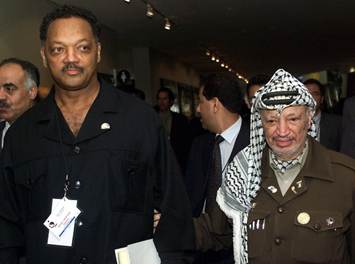
First, though, we owe respect and blessings to Rev. Jesse Jackson, who passed away last night, at the age of 84. Known for his stump slogan that recognized the equal value of every individual—“I am…somebody”—Jackson had the moral conviction to disregard American Establishment efforts to suppress discussion of Palestinian rights. Jackson met with PLO chairman Yasser Arafat multiple times, including here at the World Conference Against Racism in South Africa in 2001.
Here are Basel’s reflections on Ramadan:
“Some of us in Iqraa will be observing the fasting month of Ramadan. The month is a transformative experience, physically, mentally, and spiritually. To my fellow runners, this might be familiar. Every week of the month resembles a stretch in a race. The first mile is always the hardest, so is the first week of Ramadan. Slowly, your breathing and body find their rhythm, and you mentally elevate to a state of real confidence and drive.
This is also what you experience halfway through Ramadan when you feel closer to something higher than yourself, that there is more to life than just the dreary cycle of material consumption. That is also when you realize that you are far stronger than you thought you were, that you can get by with little food and rest and still feel happy because you thought of others and made sacrifices for them, be it God, the poor, or for Iqraa, the Palestinian students waiting to have a fair chance in the grand race that is life. That thinking of others is the essence of the Ramadan experience. As you draw closer to the finish line, you are exhausted and wobbly but happy.
That happy feeling for Iqraa runners is also mixed with a deep sense of sadness and reflection as we think about the lives of Palestinian students in the Holy Land and their daily hardships. Bittersweet are also the last days of Ramadan, when you realize that this meaningful spiritual journey, in which you were deprived of normal rest and your sustenance was constrained, has made you better in many ways. May you continue to run well, and may your Ramadan be blessed.
Saturday morning in Minneapolis was hard to take because we love our country. For the community that fights untruths and indifference to seek justice for Palestine, ICE brutality and MAGA community support for it is unsettlingly familiar.
This familiarity comes from decades of witnessing oppression in Israel-Palestine, the images and sound bites of which reverberate in America as echoing shocks in recent years, climaxing—for the moment–on January 24.
“We wake with

no words, just woe

 & wound. Our own country shoot

ing us in the back is not just brutal

ity; it’s jarring betrayal; not enforcement,

 but execution. A message: Love your people & you

 will die. Yet our greatest threat isn’t the outsiders

 among us, but those among us who never look

 within. Fear not those without papers, but those

 without conscience. Know that to care intensively,

 united, is to carry both pain-dark horror for today

 & a profound, daring hope for tomorrow. We can feel

 we have nothing to give, & still belove this world wait

ing, trembling to change. If we cannot find words, may

 we find the will; if we ever lose hope, may we never lose our

 humanity. The only undying thing is mercy, the courage to open

 ourselves like doors, hug our neighbor,

 & save one more bright, impossible life.

~Amanda Gorman, For Alex Jeffrey Pretti (2026)
Meanwhile, the everyday prose of social and political life that was our custom—friendly or heated debates over the meaning of events and the appropriate policy response—have evolved since January 6, 2021, into often righteous anger over disagreement on basic facts.
One theory of how this happened is that for too long there’s been a lack of integrity in the morality Americans believe we bring to the world. We proclaim in favor of freedom and equality–universal rights. Our actions often belie our words. Nowhere is the dual standard more manifest than on Israel-Palestine.
Why it matters
Both U.S. political parties, but especially the Democrats—who for decades claim to stand with integrity for such universal values as justice and equality—reveal a moral core hollowed by this dual standard. How much more difficult it is then to face down the lies of January 6 and after, when their MAGA purveyors throw them back, alleging hypocrisy.
In addition, the Democratic party is needlessly weakened—an own goal—by internal division between progressives who believe that everyone is equal and “progressives except on Palestine” (PEP) who make exception for Zionism, which privileges Israeli Jewish lives and narratives over all others.
Belief in the universality of equal rights is not radical, but PEP and our society more broadly treat it as such regarding Palestinians. If you doubt this, try insisting publicly on Palestinian rights and freedom at work or school or places of worship the way you might for Ukraine or against antisemitism. Results may vary—“why this bias?” … ”that’s too political” … “do you support Hamas?” or “that’s not appropriate for this campus”—but are generally not welcoming.
Nevertheless, a united progressive movement, whether that’s the Democratic party or something else, is not possible until progressives truly unite and act with integrity around our core moral values.
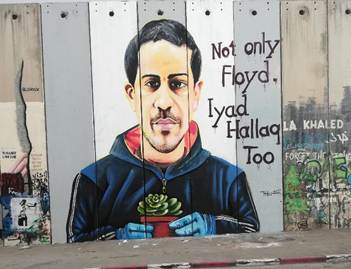
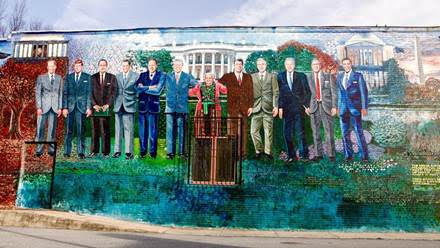
Separation Wall with image by Lushsux; honors Palestinian Iyad Hallaq, killed by Israeli police
in Jerusalem the week Minneapolis police killed George Floyd.
America and Israel-Palestine
After Israel’s 1967 war victory, America became Israel’s primary strategic patron, succeeding Britain and France. Ties became so close that Israel could rely on the US readily vetoing and hollowing UNSC resolutions critical of occupation, settlement building, and military aggression, and US condemnation or counterefforts on UNGA actions favorable to Palestine or that described Zionism as racism. Meanwhile, Americans celebrated Israeli leaders such as Prime Minister Golda Meir—the most admired woman in America in 1974, according to Gallup—who declared in 1969, “there was no such thing as Palestinians.”
Inside Israel, the political seeds of thought that justified the 1948 Nakba (Catastrophe)—driving 750,000 Palestinians from their homes—bloomed with the military occupation in 1967. The Jewish population dominated by Labor Zionism during initial immigration and the founding of the state turned steadily rightward after the 1967 war. Israel began building settlements even before the September 1967 Arab summit’s “three No’s.” By 1977, with settlement building under way for a decade—beginning in Syria’s Golan in July 1967—but growing in the West Bank, Gaza, and East Jerusalem too, the right-wing Likud replaced Labor as the dominant force in Israeli politics.
Over the decades, America directly linked both our strategic and moral outlook and our policy thinking for the region to inherently racist Israeli policies, which were implemented both inside Israel and in the occupied territories. “Racist” because only racism—whether latent and subtle or overt, cruel, and brutal—could underpin the open-ended subjugation by one people of another.
Thus, the same ‘the moral underpins the political’ dynamics that drove American slaveholding to result in Southern secession and the Civil War, have also led Israel’s occupation to result in what genocide scholars (and South Africa’s 2023 case at the ICJ) allege is genocide in Gaza. Problematically—shamefully, for the conscientious—whether Israel’s behavior is genocide or some other immoral epithet, the crisis is ongoing with worsening conditions now in the West Bank, while America continues to support Israel—financially, militarily, politically, strategically.
In an earlier moment like the one that moved Amanda Gorman, our former National Youth Poet Laureate, Mahmoud Darwish—the Palestinian national poet—wrote of Gaza. And note (as reflected in the date), that what’s happening to Gaza has happened for decades.
“Gaza has no throat. Its pores are the
ones that speak in sweat, blood, and
fires. Hence the enemy hates it to
death and fears it to criminality, and
tries to sink it into the sea, the
desert, or blood. And hence its
relatives and friends love it with a
coyness that amounts to jealousy
and fear at times, because Gaza is
the brutal lesson and the shining
example for enemies and friends
alike.
~Mahmoud Darwish, excerpt from Silence for Gaza (1973)
Today’s moment reflects our history at home and abroad, and it calls for integrity, both to purify our message and to unite us around it. For unity can bring what Gore foresaw as “profound, daring hope for tomorrow.”
The first revelation to Prophet Mohammed was the Angel Gabriel’s command to read: Iqraa!
This is not surprising. Education is central to who we are—each of us—lifting us from ignorance (jahiliyah) to ability (qidrah) and making it possible for us to make our world so much better than it is. Each of you have contributed in some way as good-change agents, bettering our world—the planet we share–because you’re educated and able.
And now, thank you to all who contributed to our 2025 campaign, Running for a brighter Palestine!—we have so many contributors who deserve thanks!
Our mission—and our most tangible contribution to brightness—is fundraising for UPA’s Mahmoud Darwish scholarship fund, and we raised $36,162, providing 36 scholarships.
So for that, thank you to our runner-fundraisers and our many donors who made it happen!
Let’s start with our runners, the heart of the Iqraa team, and thank you–to Basma, Basel and Sami, Bilal, Bill, Cathy, Imad, Jeannie, Jorge, Mazen, Peter. Reza, Sahar, Shobi, and me—for putting your trust in Iqraa, and our partnerships with MCC and UPA to register and join our team.
I earnestly hope those who signed up in 2025 but couldn’t make it are able to join in 2026.
And special thanks to the Iqraa friends who did the bulk of our fundraising, including Basma, Bilal, Bill, Cathy, Jorge, Peter, and me. And to our mystery fundraiser, Areej—alf shukr lik!
From me, thanks to many wonderful friends who contributed to the scholarship fund–calling out my Mom first for her amazing generosity every year. In addition, thank you to Anne-Marie and Larry, Andrea, Andrew, Carolyn and Carolyn, Lynn and Greg (twice!), Mary and Mary, Bill (twice!), Margaret, Lori, Chithra, Ray, Zohra, Lisa, Bob, Ginny, Lorraine, Jay, Arun, Raja, Chirag, Abba, Jai (and a matching donation!), Nancy, Barbara, Basil and Mike, Clay, and Shelby
Two NGO partners make the teamwork happen, and we’re so blessed and very grateful to have the same partners since we started Iqraa with in 2008: Marathon Charity Cooperation and United Palestinian Appeal. These are the institutions; their people who we work with are all beloved friends, some of them for 20+ years (pre-Iqraa days).
For the running and training program, that’s the MCC. Thank you to President Nick, Executive Officer Subhash, and Summer Training Program Coordinator Vandana, and Webmaster Doug, and the MCC Board, including Jay, Mazen, Seetharaman, and Shobi.
On the scholarship implementation and fundraising side, UPA works closely with us. So thank you to Executive Director Saleem, Outreach Associate Tabitha, and Donor Relations Coordinator Daniah, as well as UPA staffers Craig, Frances, Ian, Jackie, Jack, Jennifer, and Rana
Inside Iqraa, the main challenge during the year is providing the food–and Gatorade and water–to support eight training runs during the May-October training season.
Thank you to these Iqraa runners and volunteers who stepped up—more than once in most cases–to bring food on our host days or by volunteering their time: Basma, Basel, Bill, Cathy, Shobi, Siva, and me. Thanks to each of you for making it possible to feed the multitudes after the run. Extra kudos to Basma for making zaatar and manaeesh jibna when she hosted!
Thanks too to my partner coach, Cathy, who shares the seminars and for helping mark the W&OD trail for 7 runs at Reston.
Friends, we’re running for a brighter Palestine again in 2026—no surprise, and it’s our 19th year!
Our goal is a university scholarship—annual tuition—for every Palestinian student in Gaza, the West Bank, and Jordan who can’t or don’t want to leave home for their university studies.
You can help by telling your friends and family—anyone who may be interested in this noble cause, which comes with many benefits of health and friendship in addition to being a good-change agent.
For your 2026 calendar: an April 5K fun run (date TBD) and May 2, MCC’s first training run.
Let’s make 2026 a better year by Running for a brighter Palestine—and everything that represents.
At its heart, the Christmas story is about the arrival of a new era.
In the Christian narrative, Jesus was born in Nazareth in Palestine to herald a new kingdom on earth in which love and justice would prevail. It would bring true peace in which all are participants.
Christmas is a time to celebrate these possibilities…but on Palestine we’re still waiting.
We’re waiting for new ideas of living together to replace the old, in which one people claimed supremacy and sought to replace another people. For the new to arrive the old must pass.
Zionism is “the old.” There are two ways to think about replacing it. One is confronting it and exposing what it’s become. The other—our primary role given that we live in society imbued even subconsciously with values that privilege Israeli Jewish lives—is to challenge and educate ourselves.
Several years ago, resolved by the murder of George Floyd to “do something,” I took the Episcopal Church’s Sacred Ground course on racism in America, racism that subconsciously imbued our society, privileging the lives of Whites above others. The course was an awakening, but its primary lesson was that our most important action is not to “do something” outwardly, such as social action, but to invite change inwardly, transforming ourselves.
Soon after October 7—when it was already clear that Israel’s response would exceed its typical (racist-framed) “mowing the grass” military operations but before “genocide” was the widely understood description of its actions in Gaza—I attended a public, interfaith discussion of Antisemitism and Islamophobia at a nearby synagogue.
Like many, I was puzzling over the relationship of Zionism and Judaism and saw that critics of Israeli actions sought to distinguish the two. A supremacist, land-claiming ideology that elevated the state as an end and envisioned clearing indigenous people as a means is vastly different from a religion that reveres God and God’s teachings, and that recognizes the value of human life is so great that each person is a universe in itself.
Yet when I framed my question to the rabbi, on the panel to discuss Antisemitism—asking whether she recognized that critics of Israel distinguish Zionism from Judaism to prevent antisemitism–she rebuked my question as an affront to her Judaism, in effect insisting that Zionism could not be questioned.
Her defensiveness didn’t prove my point, though the distinction between faith and political ideology is manifestly obvious. But it highlighted something more broadly important about the Palestine-Israel struggle centering on the narrative: what is the meaning of what is happening—why and what are the moral lessons? –and most importantly, who can narrate.
The struggle inside Israel-Palestine—and in the region immediately beyond that’s within reach of Israel’s U.S.-provided combat weaponry–is mostly decided by force and by facts on the ground: military dominance, ethnic cleansing, and settlement expansion. But it’s the moral struggle over the narrative and who controls it—a debate that takes place mostly outside Palestine-Israel–that will decide the content and character of the new era.
And our first responsibility in this advent time is self-transformation.
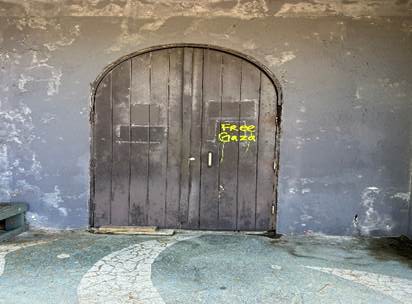
This picture is from Puerto Rico in early December and was taken in Luis Munoz Rivera park. LMR was a poet and struggler for Puerto Rican autonomy from Spain.
What a year! Seven months ago we were meeting new runners and training up for a new Iqraa season. And now it’s time for our annual holiday commemoration of the running year on Saturday at Mama Ayesha’s.
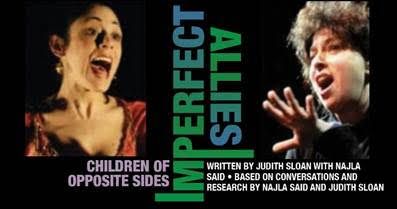
The idea of going to the theater for our team celebration may seem unorthodox but the coauthor of this play is Najla Said—Edward’s daughter—who also performs, along with her long-time Jewish friend, Judith Sloan. Najla’s aunt, Grace Said, who now lives in Beirut, is promoting the play.
“I struggled…
to reconcile the beautiful, comforting, loving world
of my home, culture, and family
with the supposed ‘barbaric’ and ‘backward’ place and society
Friends, we have so much to be grateful for, though it’s difficult to enjoy in the context of the Gaza genocide and the daily attacks against Palestinians in the West Bank.
But we are not helpless. “I am master of my fate…captain of my soul,” William Henley said (Invictus).
We are responsible for countering injustice however we can. This is not optional—it’s our moral responsibility.
Historically, in the early days of a crisis generated through oppression by the powerful against the marginalized, we–those seeking justice—are by definition the weaker party.
Rallying moral power and transforming it into the material strength needed to reverse oppression and injustice takes time. Time to convince others, to gain traction and momentum, to sway our political leaders and institutions.
There’s no guarantee of success. But the oppressed inherently have a key moral advantage in defending the marginalized and advocating for justice.
In this time of weakness when we feel alone, our strength comes from our faith in our Divine and our conviction in justice–enacted by focusing our efforts around our moral advantage.
Thankfulness comes from the knowledge of serving a just cause with friends and comrades who share this belief in justice. Alhamdulillah.
Now, please think of fundraising one last time this year—and thanks to our runners who’re taking a final shot at providing 35 university scholarships this year. We’ve raised just over $30,000, approximately 30 scholarships. We’re close and a couple of sizable donations are on the way.
For anyone waiting for the right moment to make your fundraising push: the time is Now. Palestine—the people, the land, the truth that everyone is equal—needs our support.
If you need a sign, Palestinian Christians released their Kairos II statement on November 14, 16 years after Kairos I. Whereas Kairos I called out Israel’s occupation as a sin against God and humanity, Kairos II names what’s happening in Palestine as genocide and ethnic cleansing conducted by a settler-colonial enterprise: Kairos II
Kairos is a Greek word with the meaning (spiritually) of “an opportune time” or “the right time.”
Education truly makes a difference. Let’s test that assertion: in your own experience, what degrees and learning experiences could you subtract without losing your identity and profession?
For Palestinians, education is an opportunity for bettering themselves and their communities, for rebuilding, and for articulating their existence and their rights. Education is the foundation for resisting oppression and elimination.
And yes, our contribution makes a difference. Any one of us can provide a Palestinian with a university scholarship—the tuition for one year, for approximately $1000. We don’t expect that, but simply to do what’s sustainable, whether (for our runners) to ask your friends for donations or to contribute yourself.
Thanks to all who have contributed! Here’s where you can give on our Iqraa page on the UPA website: Iqraa-UPA Partnership.
This info session will be hybrid, hosted by UPA with a Zoom option. To RSVP, please contact the Iqraa Coordinator: kirkcruachan@yahoo.com.
The Parks Half Marathon
Race DaySeptember 27, 2026
5months to go.
The Parks Half Marathon
This race is a point-to-point run that starts in Rockville MD near the intersection of Redland Rd and Sommerville Ave. After about 2 miles on Needwood Rd, runners enter Needwood Park and carry on through the urban parkland along the Rock Creek valley to Bethesda MD.
Marine Corps Marathon and 10K
Race DayOctober 25, 2026
6months to go.
The “People’s Marathon” is one of the largest marathons in the world and typically features runners from all 50 states and over 50 countries, and includes many charity runners and U.S. service men and women. It starts near Arlington Cemetery and finishes at the Iwo Jima Memorial after winding thru many scenic parts of Washington DC and the environs.


 iqraadc.org