We commemorated our Independence Day with a quiet out-of-town getaway and by considering the meaning of Independence in the context of our history and Palestine’s.
Several years ago, inspired by a seminar at my church (thank you, Bill and Lisa) about Frederick Douglass and his speech, “What To the Slave Is The Fourth Of July” (1852), the Fourth of July Iqraa message began examining the status of Palestinian liberty.
- To grasp that inspiration, here’s Democracy Now’s version, featuring James Earl Jones
This year, as one who long enjoyed NPR’s annual reading of the U.S. Declaration of Independence, it seemed appropriate to look at the Palestinian Declaration of Independence.
- NPR’s Fourth of July reading: NPR: On Reading the US Declaration of Independence
- Institute for Palestine Studies’ Palestinian Declaration of Independence
In context: The Palestinian Declaration of Independence (hereafter, Declaration) was written by national poet Mahmoud Darwish, approved by the Palestine National Council, and read aloud by Yasser Arafat on Nov 15, 1988, in Algiers.
- It explicitly accepted two states. Three weeks later (Dec 8), in response to a U.S. request, Arafat clarified that these were Palestine and “the Jewish state of Israel.”
- To this day, while nearly 160 of 193 UN member states formally recognize Palestinian statehood, Israel and the United States do not.
- Even so, Zionists—privileging the lives and narratives of Israeli Jews over all others—shamelessly use this litmus test for “antisemitism” and for whether a non-Zionist can participate in discussion over Palestine’s future: “Do you accept Israel’s right to exist?”
The Declaration. The three short sections below comprise thoughts/takeaways from the Declaration, followed by centered and italicized text of verbatim passages.
1. From its opening words, the Declaration acknowledged the land’s diversity and cultural richness, including the three faiths that share it, and the indigeneity of Palestinians.
Palestine, the land of the three monotheistic faiths, is where the Palestinian Arab people was born, on which it grew, developed and excelled…
Nourished by an unfolding series of civilizations and cultures, inspired by a heritage rich in variety and kind…The call went out from Temple, Church and Mosque to praise the Creator, to celebrate compassion, and peace was indeed the message of Palestine.
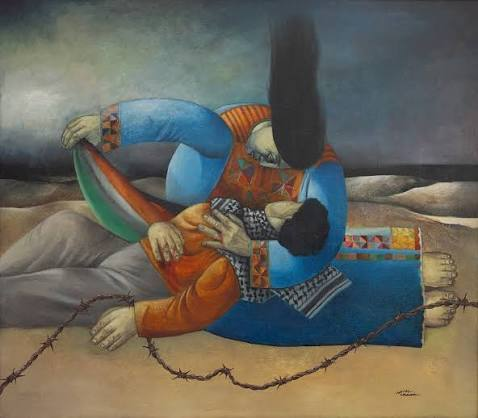
Sliman Mansour, Mother of the Martyr (1983)
2. The Declaration called out the falsehoods of Zionism—such as “a land without a people for a people without a land”–and the hypocrisy of the international state system, which determined Palestinians’ fate while rejecting their presence.
- The term “Palestinian” appears once in the League of Nations’ (LN) Palestine Mandate of 1922—in describing “acquisition of Palestinian citizenship by Jews.” In contrast, the Zionist Organization and Jewish agency were formally recognized in the LN’s Palestine Mandate and the word “Jew or Jewish appears 15 times.
- If it’s ever fair to think “the fix is in,” well…this was a fair thought more than 100 years ago.
Context for the Declaration (below) highlighting the LN (1919) and the Treaty of Lausanne (1923):
- LN Article 22 “provisionally recognized” the independence of Ottoman communities’ (such as Palestine) while entrusting their “tutelage” to the British Mandate. But the British Mandate promised the land for a Jewish national home, a promise made by Balfour in 1917.
- The Lausanne Treaty ended Turkish sovereignty over Palestine, essentially rewriting the terms of the Treaty of Sevres (1920) to gain Turkish nationalist buy-in for the British Mandate.
“…the falsehood that ‘Palestine was a land without people.’ This notion was foisted upon some in the world, whereas in Article 22 of the Covenant of the League of Nations (1919) and in the Treaty of Lausanne (1923), the community of nations had recognized that all the Arab territories, including Palestine, of the formerly Ottoman provinces, were to have granted to them their freedom…
3. The Declaration carried the optimism of the first Palestinian intifada (“shaking off”), then underway for a year (it began in Dec 1987). Its authors couldn’t have anticipated that the occupation and denial of their freedom would continue to this day.
The massive national uprising, the intifada, now intensifying in cumulative scope and power on occupied Palestinian territories…have elevated awareness of the Palestinian truth and right into still higher realms of comprehension and actuality…The intifada has set siege to the mind of official Israel, which has for too long relied exclusively upon myth and terror to deny Palestinian existence altogether…the history of Palestine has therefore arrived at a decisive juncture.
Regarding the U.S. relationship to Palestine, Abraham Lincoln’s 1859 letter to a friend may best capture the expectation of many: “Those who deny freedom to others deserve it not for themselves and under a just God cannot long retain it.”
The spirit behind this sentiment is universal, widely known as karma, and is biblically familiar in the phrase, “You shall reap what you sow.” But in Lincoln’s letter, the moral faultline is more specific: the freedom-denying sentiment came from “the vanguard…of returning despotism.”
Understanding this moral faultline and confronting that despotic vanguard is our own “decisive juncture” and it’s intrinsically connected–by the values inherent to cherishing Liberty–to our approach to Palestine.
Kirk


Leave a Reply