This week we’re featuring two poems from Zeina Azzam, a Palestinian American poet, community activist, and Iqraa alum. And please note the public service announcements between Zeina’s poems.
Poet laureate. Zeina was the poet laureate of Alexandria, VA, for 2022-25, and has authored several poetry books, which can be ordered on her website. Her professional career focuses on education and Middle East affairs, including 27 years at Georgetown’s Center for Contemporary Arab Studies and her current work as poetry editor for We Are Not Numbers.
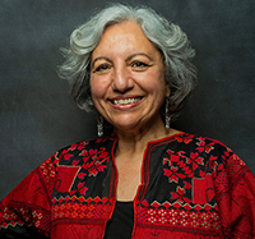
The idea behind Zeina’s first poem: “One day it struck me how central the concept of KHAYR, the Arabic word for goodness, is to Arab culture. The Arabic word khayr is uttered often during each day. How lovely is it that one of the major touchstones of our lives is the idea of goodness, and we use it in our speech and with each other all the time!
Khayr
From the time farmers rise with the sun
until night descends, there is talk of it—
songs and Qur’anic verses about khayr,
morning of khayr, evening of khayr.
There is no getting around goodness.
Tisbahi ala khayr, my mother would wish me
as she kissed my forehead at bedtime:
may you wake up to goodness. Later I learned
to respond: w’inti min ahlo, may you be
part of its family—the family of khayr.
Even watching TV, as we waited for bad
news from Gaza, she would admonish,
khayr inshallah! Goodness, God willing!
No matter the misfortune, she was sure Allah
would eventually bring khayr to Palestine.
Maybe it all started with her neighbors
in Jaffa, the family whose name was
Khayrallah, God’s goodness. From kindness
to comity, their ancestors packed so much
in this name: it was a hedge against hardship,
an incantation in their bones—Palestine’s
bones—where khayr resides from morning
till night, in a mother’s kiss at bedtime, deep
in a farmer’s land. There, the roots of khayr
multiply in the earth, goodness bristling.
Zeina Azzam. Originally published in Mizna: The Palestine Issue (2019) and included in Zeina Azzam, Some Things Never Leave You (Tiger Bark Press, 2023).
Public Service Announcements: we have four PSAs that distill into Volunteering and Learning.
- Volunteer. We need a few more volunteers for the Sept 5 Abebe Bikila International Peace Marathon and Half on the C&O towpath (adjacent to Canal Rd). Let me know if you can be one.
- On Sept 4 (Friday), Help with logistics (loading/moving supplies). This is our biggest need at the moment.
- On race day Sept 5 (Saturday), Volunteer for aid station support (giving Gatorade/water to runners), or logistics (loading/moving supplies).
- Thank you to volunteers thus far: Bilal, Bill, Cathy, Greg, Nourman, Shobila, Tom, and me.
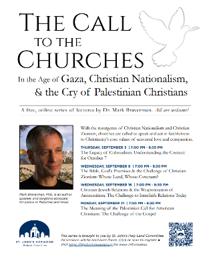
- Learn. Free Zoom series hosted by my church, featuring Mark Braverman: Sept 3: colonialism…the context for Oct 7; Sept 9: the challenge of Christian Zionism; Sept 16: Christian-Jewish relations and the weaponization of antisemitism; Sept 21: the Palestinian call to American Christians.
- Register to get Zoom link and reading list: Four-part series. Free…All are welcome!
- Learn. Book review. This is the correct link (last week’s malfunctioned) to my review in Mondoweiss of Ramsey Hanhan’s book: Book review: Palestine Bleeds For You
- Learn: Museum of the Palestinian People. We started this tradition last year and paired it with a trip to the nearby Nabiha’s restaurant. It became a good, educational afternoon and an opportunity to talk together. We’ll meet after one of the 12-mile runs, on Sept 19 or 26.
End PSAs
Hope for Gaza. Zeina shared her thinking that led to this second poem.
“When a friend asked me to write a hopeful poem about Gaza, I realized how much of a challenge I faced. I feel profound grief and despair (and rage) as the genocide continues to unfold in Gaza since 2023. Then I came across an essay by the Palestinian pastor, Rev. Munther Isaac. He was the one that constructed the “Christ in the Rubble” scene at Christmas Lutheran Church in Bethlehem, and in 2025, the church added a Christmas tree coming out of the rubble. Rev. Isaac saw the tree as symbolizing “defiance in the face of death. It is hope planted where despair is expected to rule… We live amid ruins, yet we insist on life. We bury our dead, yet we plant trees.” His moving words inspired me to write this poem.
We Plant Trees in Genocide
“We bury our dead, yet we plant trees.”—Rev. Munther Isaac, Palestinian Christian Pastor in Bethlehem, West Bank, Palestine
The earth knows us. We trust soil, sun, rain.
On this same land, bombs land.
We bury our dead. We bury our trees.
Yet our children gather seeds.
They ask us to imagine oranges and pears.
We are summoned by the name of cactus fruit: صبر sabr, patience.
And fists will open, will plant.
Our ancestors, at peace in death: the roots, the love we know.
They are the earthworms, minerals, oxygen,
old branches and stones anchoring trees.
In our homeland we thirst for water and light.
We dream of farming, even in hunger.
Below, tears and breaths mingle, a helix in the soil.
Hopeful tendrils curl toward the sun.
©️Zeina Azzam. Published in Caroline Bock & Jona Colson, eds., Capital Love (Washington Writers’ Publishing House, 2026).
Last week/this week: last week we ran at Columbia Island Marina and this week we’re at Reston for 16 miles (marathoners) or 9 miles (Half). Please sign up by Thursday each week so the host charity can plan for refreshments.
Friends, hope lives through action—whether serving water to runners, planting trees for Gaza, or running for a brighter Palestine—and there is always so much more that we can do.
As in a long run…pace yourself, lean forward, and never quit.
Kirk


Leave a Reply