This week’s message features Samar’s reflections on her Marine Corps Marathon and a poem of pride in identity that is very relevant to this moment in history, Sajil Ana Arabi (Record! I am an Arab).
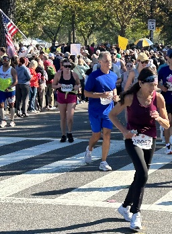
Rounding the corner at Mile 19
Samar’s thoughts after the MCM: Education: Allowing Palestinians a chance at life.
“I would like to say that it does get harder every year as our bones and muscles tire, but the feeling of exuberance remains, when you start and finish. All the miles in between are spent talking to yourself and saying you can make it. I listened to Arabic songs as I ran and looked at the fallen soldiers [the “wear blue” mile at Hains Point] whose lives were taken by useless wars some as late as October 26. The Marine Corps Marathon is never just a strain on your body but also on your mind because your thoughts have time to amply germinate. But the one thought that takes hold is that we are raising money for education and allowing Palestinians, under extreme stress and injustice from the cradle to the grave, to have a chance at life.
- Running the numbers. Samar ran a 4:26.44 marathon, finishing 86th of 417 female runners in her age category, essentially, the top 20.6 percent of her group.
- Favorite sign? “Mile 22.. never again. Mile 26.2, when is the next race?”
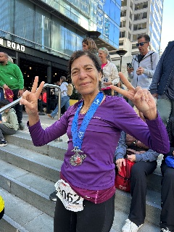
Wearing the MCM finisher’s medal!
The prerace MCM security restrictions have increased. Last year’s security restrictions have intensified. This year not only was the entire Camp Rosslyn area (the parking lot in front of River Place apartments) fenced off, but runners could not walk from Camp Rosslyn to the start line on Rte 110. Instead, we had to take the metro from Rosslyn to the Pentagon and then walk to the start line; beyond a certain point, only runners with bibs were permitted, so Samar had to walk the final distance to the start alone.
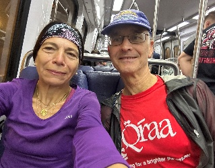
On the metro from Rosslyn to the Pentagon
In tribute to all our runners this year, here’s Mahmoud Darwish’s “Record! I am an Arab”… after a description of its relevance at this moment of rising racism and Islamophobia in America that matches the increasing Jewish supremacy in Palestine.
- The poem reflects a pride in Arab identity that every Iqraa runner shares. We share this pride not only because of our near 20-year focus on elevating the prospects for Palestinians, but because we recognize the overlap of ethnoreligious supremacist threats—Christian nationalists in America and Jewish nationalists in Palestine—is a threat to all.
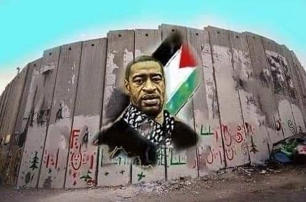
- We seek nothing less and nothing more than equality. But we insist on it. Neither White supremacy nor Zionism—which privileges the lives and narratives of Israeli Jews over all others—are acceptable, nor is anti-semitism. Palestinians recognize these principles more personally than most Americans, and created murals of George Floyd on the separation wall in the West Bank.
Rashid Khalidi described Darwish as one of the finest poets of his entire generation—in Palestine certainly. Born in Mandate Palestine in 1941, he experienced expulsion, flight, and the loss of his home as a small child. He grew up in the Galilee, an “internal refugee” in a village near his destroyed birth village of al-Birwa. His education included time in an Israeli prison where in 1964 he wrote one of his most famous poems, “Sajjil ana ‘arabi” (“Record! I Am an Arab”; it was published in English under the title “Identity Card”).
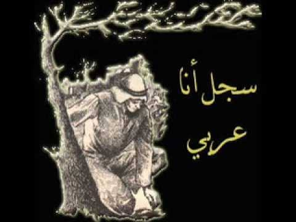
The Arabic text next to this farmer translates as “Record! I am an Arab.”
Identity Card
Record!
I am an Arab
And my identity card is number fifty thousand
I have eight children
And the ninth is coming after a summer
Will you be angry?
Record!
I am an Arab
Employed with fellow workers at a quarry
I have eight children
I get them bread
Garments and books
from the rocks..
I do not supplicate charity at your doors
Nor do I belittle myself at the footsteps of your chamber
So will you be angry?
Record!
I am an Arab
I have a name without a title
Patient in a country
Where people are enraged
My roots
Were entrenched before the birth of time
And before the opening of the eras
Before the pines, and the olive trees
And before the grass grew
My father.. descends from the family of the plow
Not from a privileged class
And my grandfather..was a farmer
Neither well-bred, nor well-born!
Teaches me the pride of the sun
Before teaching me how to read
And my house is like a watchman’s hut
Made of branches and cane
Are you satisfied with my status?
I have a name without a title!
Record!
I am an Arab
You have stolen the orchards of my ancestors
And the land which I cultivated
Along with my children
And you left nothing for us
Except for these rocks..
So will the State take them
As it has been said?!
Therefore!
Record on the top of the first page:
I do not hate people
Nor do I encroach
But if I become hungry
The usurper’s flesh will be my food
Beware..
Beware..
Of my hunger
And my anger!
~Mahmoud Darwish
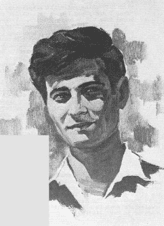
Darwish in his youth (1941-2008)
“Teaches me the pride of the sun
Before teaching me how to read”
Kirk


Leave a Reply