I started this message intending “Transition!” to mark my retirement from the Department of Defense last Friday, and to include a Mahmoud Darwish poem to mark the occasion. We’ll get to that.
But election night on Nov 3 highlighted a more significant Transition, including the election of many Americans who represented the “First” of their demographic group to serve in their position.
- Firsts demonstrate to young people of varying ethnic and religious backgrounds and sexual orientation that they can pursue possibilities they hadn’t previously imagined.
- Firsts also bring different intellectual perspectives into leadership, helping to bolster creative thinking and avoid groupthink.
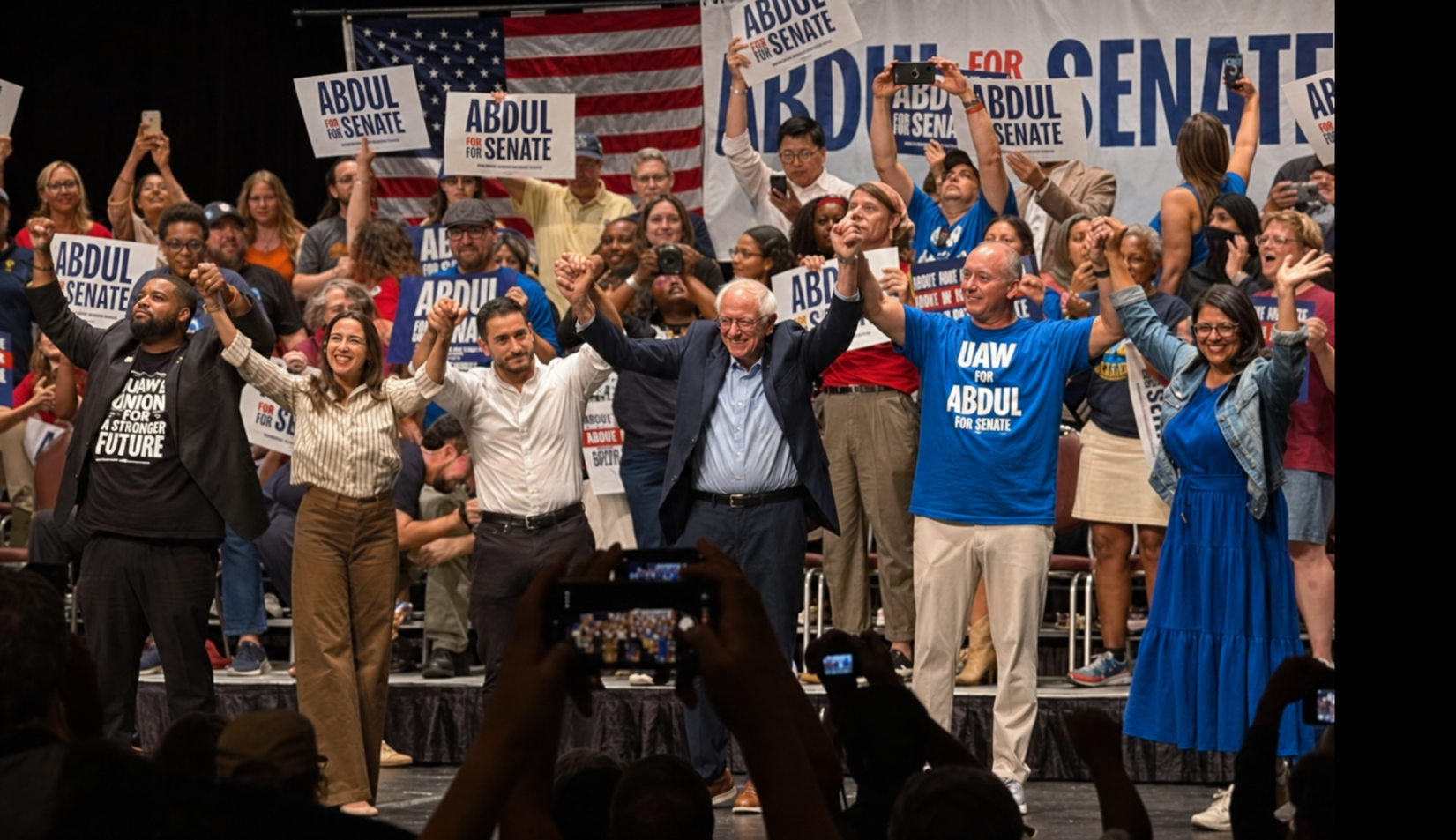
July 20 Detroit rally reflects wide-ranging demography of Palestine rights supporters, such as McKinney, AOC, AES, Bernie, Fain, and Rashida.
These attributes—new energy, different perspectives, and the coalition building minorities in particular engage in—are crucial for a society in need of reimagining itself and finding new avenues of growth—as vibrant societies must do. Among America’s Firsts on Nov 3:
- Muslim Senator: Abdul El-Sayed (Michigan)
- Openly gay male Senator: Chris Pappas (New Hampshire)
- Native American female Senator: Peggy Flanagan (Minnesota)
- Elected female Senator in South Carolina: Annie Andrews
- Black female governor: Keisha Lance Bottoms (Georgia)
- Black governors in their states: David Crowley (WI), Aaron Ford (NV), Byron Donalds (FL)
- Latina governor of Texas: Gina Hinojosa
- Native American female governor: Deb Haaland (New Mexico)
Before relaying what I passed on to my team upon retiring, I want to share Palestinian national poet Mahmoud Darwish’s “O water, be a string to my guitar,” as it captures feelings and images of transition. Darwish speaks of different and acute—societally traumatic–eras of transition, metaphorically visible in in the poem’s title, while painting images that apply to the passage of eras at personal as well as historical levels.
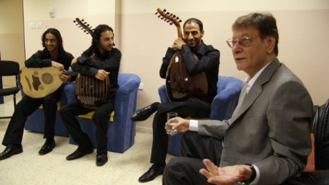
Darwish with the French Palestinian oud troupe, Le Trio Joubran, originally from Nazareth and compelled by Israeli restrictions to operate more from Paris and Ramallah.
O water, be a string to my guitar
O water, be a string to my guitar. The conquerors arrived,
and the old conquerors left. It is difficult to remember my face
in the mirrors. Water, be my memory, let me see what I have lost.
Who am I after this exodus? I have a rock
with my name on it, on a hill from which I see what’s long gone…
Seven hundred years escort me beyond the city wall…
In vain time turns to let me salvage my past from a moment
that gives birth to my exile…and others’…
To my guitar, O water, be a string. The conquerors arrived,
And the old conquerors left, heading southward, repairing their days
In the trashheap of change: I know who I was yesterday, but who will I be
in a tomorrow under Columbus’ Atlantic banners? Be a string,
be a string to my guitar, O water! There is no Misr in Egypt,
No Fez in Fez, and Syria draws away. There is no falcon in
my people’s banner, no river east of the palm groves besieged
by the Mongols’ fast horses. In which Andalusia do I end? Here
or there? I will know I’ve perished and that here I’ve left
the best part of me: my past. Nothing remains but my guitar.
Then be to my guitar a string. O water. The old conquerors left,
the new conquerors arrived.
My own transition. This week marks the start of my transition after officially retiring on Oct 30; it’s been 45 years since I joined the Infantry to serve in West Germany during the Cold War. After my 4-year military commitment, the remaining 41 years were dedicated to national security service in the Department of Defense as a Middle East analyst and/or graduate studies to better understand the Middle East.
In my retirement remarks to my team, which I was fortunate to share also with Shobila and a few friends from outside my workplace, I highlighted the need for a humanistic approach to the Middle East, based on better understanding the culture and perspectives of the region’s people and leading actors.
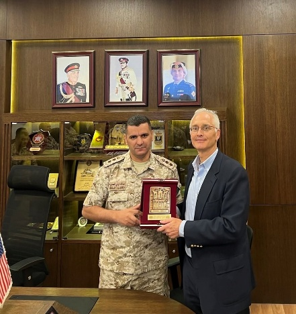
With a Jordanian counterpart in Amman (2023)
My remarks were organized around my emotions upon retiring, culminating with the case for a humanistic approach to analysis:
- Living in the West Bank, Israel, and Lebanon as a boy filled me with wonder.
- Serving with my teammates on our elite analytic unit was the honor of a lifetime.
- It became clear across decades of service that every administration, Republican or Democratic, acts primarily on the basis of its domestic constituency’s wishes.
- The civil-servant analyst’s role, regardless of policy outcomes, was to answer questions about trends, risks, and opportunities, and most importantly in accordance with the DIA credo, to speak Truth to Power.
- The questions we addressed centered on political-military issues and military capabilities but understanding the perspectives of leaders and communities is key to a holistic understanding.
- The context for these perspectives comes from understanding the people and their culture.
- Most of my focus was on understanding the Arab and Muslim world; studying Arabic and traveling in the region were integral to that.
- Cultural insights also come from reading literature—for instance, contrast Naguib Mahfouz’s Palace Walk trilogy written in the 1950s with Yasmina Khadra’s series written 50 years later that includes The Attack and The Sirens of Baghdad. And read non-fiction, of course.
- For reading poetry, I offered Mahmoud Darwish as an example, and for film-viewing, The Battle of Algiers as a starting point.
My takeaways for my team highlighted Palestine’s importance to me. My bio for the retirement ceremony’s program—filled with pictures of travel in the region–mentioned founding Iqraa in 2008 to support Palestinian students, and my Farewell email to the Middle East Africa Regional Center noted that in retirement I’d be active on Palestine.
Now, as my Mom always said, we “Press on!”
Kirk


Leave a Reply